








Estimated Reading Time: 20-25 minutes (4,087 words)
Introduction
The Indian Direct-to-Consumer (D2C) revolution is rewriting the rules of modern retail. In just the last few years, homegrown brands have bypassed traditional distribution models to connect directly with customers through digital platforms, social media, and e-commerce. What started as a niche experiment has now turned into a multi-billion-dollar movement — transforming how Indians shop, engage, and trust brands.
According to Inc42 and Statista, India’s D2C market is projected to cross $60 billion by 2027, growing at a CAGR of over 40%, one of the fastest rates globally. Fueled by rising disposable income, smartphone penetration, and post-pandemic digital adoption, new-age Indian brands like boAt, Mamaearth, Lenskart, and Wow Skin Science are not just thriving — they’re dominating their categories and going global. These brands have mastered the art of personalization, storytelling, and community building — three pillars of the D2C revolution.
Unlike legacy players, today’s D2C startups use data-driven marketing, influencer collaborations, and AI-powered supply chains to deliver what consumers truly want — speed, transparency, and authenticity. This direct connection has created a new level of trust, where the brand-customer relationship extends beyond just a purchase to an emotional bond. Whether it’s skincare, electronics, or food, these brands are setting new benchmarks for innovation and customer experience.
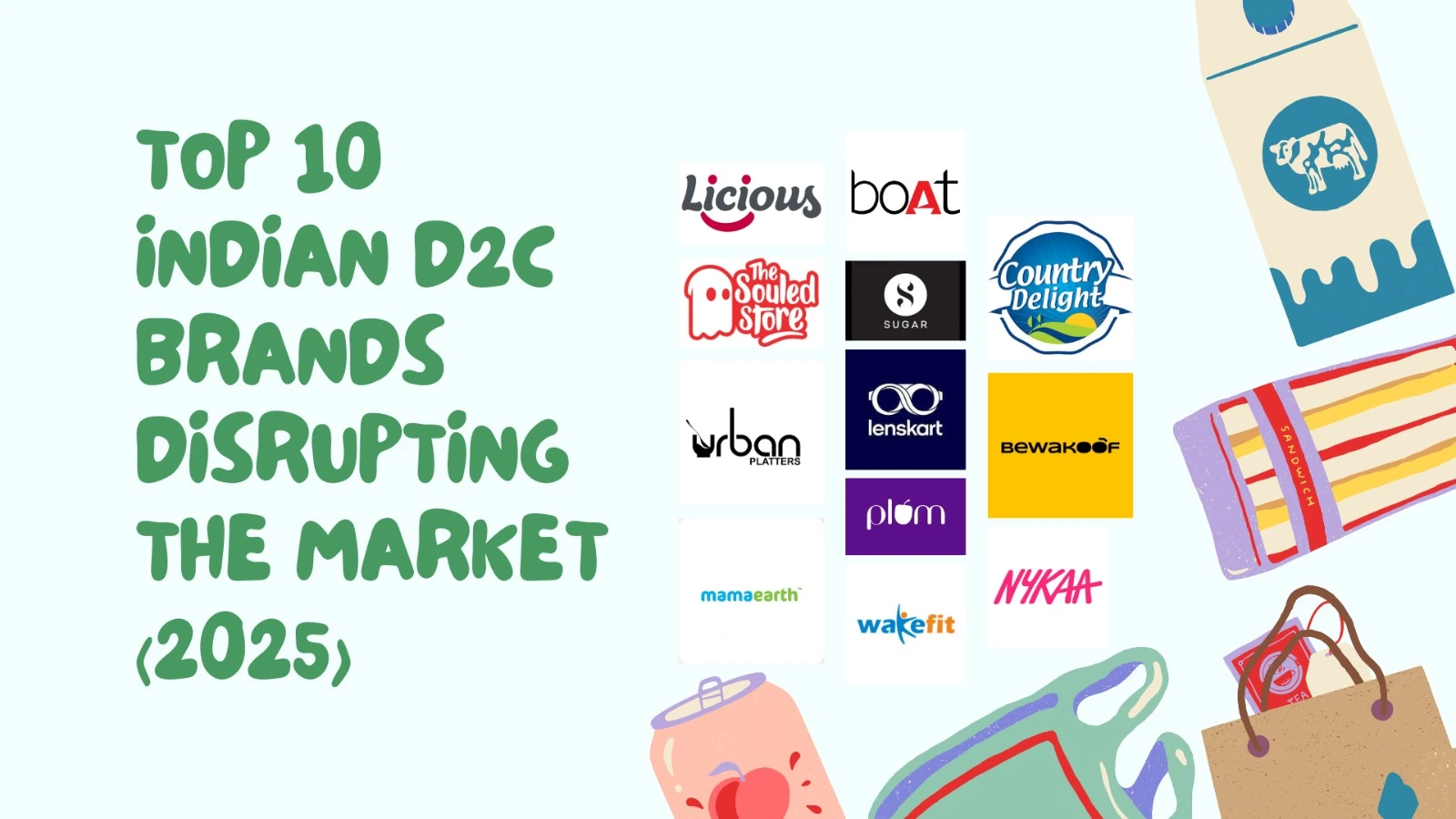
In this blog, we’ll explore the Top 10 Indian D2C Brands Disrupting the Market in 2025 — uncovering how they’ve scaled rapidly, what strategies fuel their growth, and what global lessons entrepreneurs and marketers can learn from their journey. Whether you’re an investor, business owner, or digital marketer, this deep dive will give you actionable insights into the future of India’s D2C boom.

Executive Summary (Quick Take)
- India’s D2C ecosystem has gone mainstream, emerging as one of the fastest-growing consumer engines in Asia. The sector includes a dynamic mix of:
- IPO-listed and near-public brands like Nykaa, boAt, and Honasa (Mamaearth)
- Fast-scaling private players such as Lenskart, Licious, and Wakefit
- Indie and niche innovators like Plum, Minimalist, and The Man Company
- IPO-listed and near-public brands like Nykaa, boAt, and Honasa (Mamaearth)
- What sets them apart: These brands own the entire value chain — from product creation to customer experience — allowing them to:
- Control pricing, feedback loops, and product innovation
- Leverage first-party customer data for personalization and retention
- Build subscription and repeat purchase models
- Drive growth through influencer-led and creator-driven marketing
- Optimize fulfillment with in-house logistics and smart automation
- Control pricing, feedback loops, and product innovation
- Why it matters: The Indian D2C market is projected to touch $60 billion by 2027 (Statista, Inc42), supported by 40%+ annual growth, rising disposable incomes, and expanding online shoppers (expected to reach 400 million by 2025).
- For content creators and publishers: D2C topics are a goldmine for SEO — combining:
- High-CPC keywords in beauty, home improvement, lifestyle, and premium goods
- Branded search traffic from curious consumers
- Strong affiliate and ad monetization potential from product links and review-based content
- High-CPC keywords in beauty, home improvement, lifestyle, and premium goods
- In short: India’s D2C movement is not just a retail story — it’s a digital-first disruption redefining how products are built, marketed, and experienced globally.
Why D2C matters — market context & 10-year outlook
Headline market signals (load-bearing facts):
- India’s e-commerce market continues rapid expansion, and D2C forms an increasing share as brands prefer owning first-party customer relationships. Recent industry coverage places India’s e-commerce scale in the tens to hundreds of billions USD and shows strong multi-year growth. modifyed.in
- Public and private filings show large Indian D2C names growing revenue: e.g., Nykaa’s beauty sales and profitability improvements reported in 2025; Honasa/Mamaearth targets double-digit growth via retail expansion. Reuters+1
- Premium and subscription categories (beauty, sleep/mattresses, meat/food subscription) are investor favorites; Lenskart’s FY25 results and Licious IPO plans are examples of large scale and IPO-readiness in the segment. finnovate.in+1
10-year outlook (2025 → 2035):
- D2C in India will mature — more IPOs, larger omnichannel plays and category consolidation. Winners will be those with strong first-party data, high retention/subscription rates and efficient unit economics. Expect continued growth in beauty, health & wellness, personal tech (audio), home/sleep, premium food and petcare.
Key Drivers & Risks
🚀 Key Growth Drivers of India’s D2C Revolution
- Short-Form Content & the Creator Economy → Low-Cost Discovery & Conversions
Platforms like Instagram Reels, YouTube Shorts, and Moj have transformed how Indian consumers discover new brands. Micro-influencers and content creators now act as authentic discovery engines, generating high engagement at relatively lower costs than traditional ads.
- According to Redseer, over 75% of D2C brand discovery among Gen Z and millennials happens via short-form content and influencer-led storytelling.
- Example: The Man Company and Plum Goodness built awareness through relatable creator collaborations and educational Reels, achieving organic reach at a fraction of typical ad spend.
- According to Redseer, over 75% of D2C brand discovery among Gen Z and millennials happens via short-form content and influencer-led storytelling.
- UPI & Digital Payments → Frictionless Checkout & Higher Repeat Purchases
India’s fintech backbone — led by UPI, Razorpay, Paytm, and PhonePe — has eliminated checkout friction. With monthly UPI transactions crossing 13 billion in 2025 (NPCI data), payments are instant, secure, and trusted.
- D2C brands leverage subscription models and one-tap reorders, encouraging loyalty and convenience.
- Example: boAt and Wakefit use integrated wallets and EMI options to boost conversion rates among young consumers.
- D2C brands leverage subscription models and one-tap reorders, encouraging loyalty and convenience.
- Smarter Logistics & Tier-2/3 Penetration → Wider Profitability
India’s logistics landscape has matured with Shiprocket, Delhivery, and Pickrr powering third-party D2C deliveries.
- These logistics enablers now offer 2–4 day delivery even in Tier-3 cities, making D2C brands competitive beyond metros.
- According to Entrackr, over 60% of new D2C customers now come from Tier-2 and Tier-3 cities, indicating strong non-metro growth potential.
- Example: Licious and Mamaearth have successfully scaled pan-India using regional warehouses and temperature-controlled delivery systems.
- These logistics enablers now offer 2–4 day delivery even in Tier-3 cities, making D2C brands competitive beyond metros.
⚠️ Key Risks & Challenges in the D2C Ecosystem
- Rising Customer Acquisition Costs (CAC) & Shrinking Margins
With more brands fighting for attention on Meta and Google Ads, CACs have risen by 25–40% year-on-year (Business Standard, 2025). As paid marketing gets expensive, smaller D2C players struggle to sustain profitability. - Marketplace Private Labels & Global Entrants Increasing Competition
Giants like Amazon, Flipkart, and Meesho now promote their own private labels, directly competing with niche D2C brands. Simultaneously, global brands like The Ordinary, Glossier, and Dyson are expanding into India, raising the bar for product quality and pricing. - Quality Control, Returns, and Scale Issues in Perishable & FMCG Categories
Fast-moving categories such as F&B, personal care, and wellness face scalability challenges — maintaining freshness, managing high return rates, and ensuring consistent quality.
- Example: Licious and Country Delight must balance cold-chain logistics costs with margin pressures.
- Failure in quality consistency can quickly erode consumer trust — the most valuable currency in D2C.
- Example: Licious and Country Delight must balance cold-chain logistics costs with margin pressures.
🧭 Summary Insight
India’s D2C ecosystem thrives on digital convenience, personalization, and trust — but its future success will depend on sustainable customer acquisition, operational efficiency, and brand differentiation. Those who blend tech, storytelling, and logistics smartly will lead the next phase of growth.
Top 10 Indian D2C Brands — Profiles, Tactics, Numbers & Monetization Hooks
India’s Direct-to-Consumer (D2C) ecosystem is booming — spanning beauty, electronics, food, and home categories. These 10 brands are redefining consumer experiences through direct engagement, tech-led marketing, and community-driven storytelling.
Below is a breakdown of each leading brand — including its profile, recent financial or IPO signals, growth tactics, SEO-friendly content hooks, and monetization ideas for bloggers and publishers.
1️⃣ Mamaearth (Honasa Consumer Ltd) — Personal Care & Beauty
Why It’s Disruptive:
Mamaearth revolutionized India’s skincare and personal care industry by promoting toxin-free, eco-conscious products. Starting with baby care, it expanded into mass beauty, capturing India’s middle-class consumer base with natural positioning and influencer-led trust.
Latest Signals (2025):
Parent company Honasa Consumer Ltd (listed entity) continues to show robust growth, reporting steady revenue increases and retail expansion in its FY25 filings. Focus remains on product rationalization, tier-2 penetration, and omnichannel sales (Source: Reuters, Economic Times).
Tactics:
- Heavy creator and celebrity marketing (Alia Bhatt, Shilpa Shetty).
- User-generated reviews and dermatologist-endorsed claims.
- Expansion from D2C to retail and marketplaces (Nykaa, Amazon, Flipkart).
SEO/Publisher Hooks:
- “Is Mamaearth good for oily skin?”
- “Best Mamaearth products 2025”
- “Mamaearth vs WOW Skin Science comparison”
- “Mamaearth coupon codes & cashback deals”
Monetization Ideas:
- Affiliate links for bestsellers (via Amazon or Mamaearth partner program).
- Product review blogs and YouTube demo videos with affiliate cards.
- Email funnels for replenishment reminders and exclusive coupon drops.
2️⃣ boAt — Consumer Audio & Lifestyle Accessories
Why It’s Disruptive:
boAt redefined the affordable premium audio segment with fashionable, youth-driven designs. It positioned earphones and wearables as lifestyle accessories rather than just gadgets.
Latest Signals (2025):
boAt returned to profitability in FY25 and is reportedly preparing for its IPO, with revenue recovery across domestic and export markets (Source: Moneycontrol, ET Tech).
Tactics:
- Influencer collaborations (IPL, musicians, creators).
- Limited-edition product drops and festive campaigns.
- Multi-channel approach: boAt website + marketplaces (Amazon/Flipkart).
SEO/Publisher Hooks:
- “Best boAt earbuds under ₹3,000 in 2025”
- “boAt vs Noise vs OnePlus comparison”
- “boAt smartwatches with Bluetooth calling”
Monetization Ideas:
- Affiliate roundups of “Top 10 boAt gadgets.”
- Coupon pages and comparison posts.
- Unboxing or tech demo videos with embedded affiliate cards.
3️⃣ Nykaa (FSN E-Commerce Ventures) — Beauty & Cosmetics
Why It’s Disruptive:
Nykaa pioneered India’s beauty e-commerce landscape with an omnichannel model, celebrity tie-ups, and private labels like Kay Beauty.
Latest Signals (2025):
Public filings show strong quarterly profits, driven by premium beauty demand and new product lines. Nykaa continues to expand into men’s grooming and wellness while enhancing its ESG disclosures (Source: Reuters, Mint).
Tactics:
- Private label mix + marketplace model.
- CRM-based recommendations and loyalty programs.
- Celebrity endorsements and influencer partnerships.
SEO/Publisher Hooks:
- “Nykaa vs Sephora vs Amazon – which is better?”
- “Nykaa offers and coupon codes 2025”
- “Top Nykaa skincare brands for Indian skin”
Monetization Ideas:
- Join Nykaa affiliate program.
- Curate makeup gift guides and tutorials.
- Promote seasonal offers and influencer collabs through blogs and reels.
4️⃣ Lenskart — Eyewear & Vision Tech
Why It’s Disruptive:
Lenskart integrated tech, manufacturing, and retail into one ecosystem, making eyewear affordable, stylish, and digitally accessible.
Latest Signals (2025):
Lenskart is reportedly IPO-ready, showing significant profitability and expansion across India and Southeast Asia (Source: finnovate.in, Entrackr).
Tactics:
- AR-powered virtual try-ons.
- In-house lens manufacturing and store expansion.
- Collaborations with insurance partners for coverage inclusion.
SEO/Publisher Hooks:
- “Best budget eyeglasses in India 2025”
- “Lenskart coupon codes and sale alerts”
- “How to renew your lenses online – step-by-step guide”
Monetization Ideas:
- Affiliate tie-ups for glasses and lenses.
- Sponsored content with optometrists or vision-care blogs.
- Local store reviews with referral links.
5️⃣ SUGAR Cosmetics — Makeup for Gen Z
Why It’s Disruptive:
SUGAR Cosmetics has captured Gen Z and millennial audiences through fun, bold, social-first campaigns and rapid trend-based product drops.
Latest Signals (2025):
While showing revenue volatility, SUGAR remains a strong youth brand with active retail expansion and global influencer tie-ups (Source: Tracxn, YourStory).
Tactics:
- Trend-based limited edition launches.
- Micro-influencer partnerships across Instagram and YouTube.
- Interactive gamified loyalty app for engagement.
SEO/Publisher Hooks:
- “Is SUGAR Cosmetics cruelty-free?”
- “Top SUGAR lipsticks for dusky skin”
- “SUGAR Cosmetics vs Maybelline comparison”
Monetization Ideas:
- Affiliate links for top-rated products.
- Makeup tutorials with affiliate tagging.
- “Viral product dupes” articles for SEO.
6️⃣ Wakefit — Sleep & Home Solutions
Why It’s Disruptive:
Wakefit built a D2C empire in the home segment with scientifically designed mattresses, ergonomic furniture, and sleep accessories, backed by stellar service and trust.
Latest Signals (2025):
Filed for IPO listing, showing strong FY25 revenue performance and high repeat purchase rates (Source: Entrackr, Business Today).
Tactics:
- Long trial & warranty periods to boost consumer trust.
- SEO-driven sleep health content marketing.
- Subscription bundles for home goods.
SEO/Publisher Hooks:
- “Best mattress in India 2025 comparison”
- “Wakefit vs SleepyCat vs Sleepwell”
- “Mattress buying guide for Indian homes”
Monetization Ideas:
- High-ticket affiliate revenue (₹20k+ AOV).
- Downloadable mattress buying checklists.
- Sponsored home decor or furniture reviews.
7️⃣ Plum & Minimalist — Indie Clean Beauty
Why It’s Disruptive:
Both brands symbolize India’s clean beauty and transparency movement, built around ingredient education and dermatologist trust.
Latest Signals (2025):
Minimalist has reported improved margins and profits, while Plum is expanding its vegan product lines and omnichannel reach (Source: Inc42, Mint).
Tactics:
- Ingredient explainers and educational blogs.
- Subscription models with routine-based bundles.
- Dermatologist-backed brand messaging.
SEO/Publisher Hooks:
- “Minimalist vs The Ordinary – which works better?”
- “Niacinamide vs Hyaluronic Acid guide”
- “Best clean skincare brands in India 2025”
Monetization Ideas:
- Affiliate skincare reviews.
- Downloadable skincare routine planners.
- Sponsored dermatologist Q&A features.
8️⃣ Licious — Fresh Meat & Ready-to-Cook Foods
Why It’s Disruptive:
Licious redefined meat retail in India with cold-chain logistics and freshness guarantees, making it a benchmark for perishable D2C operations.
Latest Signals (2025):
Reports indicate IPO ambitions (2026 target) and strong expansion into ready-to-eat and retail stores (Source: Reuters, Entrackr).
Tactics:
- In-house supply chain for freshness assurance.
- Subscription and loyalty models.
- Recipe integrations and chef collaborations.
SEO/Publisher Hooks:
- “Best online meat delivery in India”
- “Licious offers and coupons 2025”
- “Top ready-to-eat meal brands in India”
Monetization Ideas:
- Affiliate tie-ins with recipe posts or kitchen gadgets.
- Sponsored meal kit reviews.
- Referral programs for subscription sign-ups.
9️⃣ Bewakoof / The Souled Store — Youth Apparel & Merch
Why It’s Disruptive:
These brands turned pop culture into commerce — leveraging fan-based merchandise, humor-driven marketing, and UGC (user-generated content).
Latest Signals (2025):
Both continue to grow profitably with celebrity collabs and movie/show-based collections (Source: YourStory, ET Tech).
Tactics:
- Limited edition drops and collaborations.
- Community-driven design contests.
- Creator-based marketing campaigns.
SEO/Publisher Hooks:
- “Best quirky t-shirts in India 2025”
- “Bewakoof vs The Souled Store quality review”
- “Exclusive Marvel/Anime merch India”
Monetization Ideas:
- Affiliate storefronts for merch sales.
- Gift guide blogs for festivals or fandoms.
- Influencer collab coverage with affiliate links.
🔟 Country Delight / Urban Platter — FMCG & Subscription Staples
Why It’s Disruptive:
Country Delight and Urban Platter have digitized daily grocery delivery and healthy pantry essentials, focusing on freshness, traceability, and consistency.
Latest Signals (2025):
Expanding beyond metros into suburban clusters, both are optimizing AI-driven supply chains and launching health-centric SKUs (Source: Inc42, Mint).
Tactics:
- Subscription-first model (daily milk, ghee, staples).
- Farm-to-home traceability tech.
- Sustainability-focused packaging.
SEO/Publisher Hooks:
- “Is Country Delight milk worth it?”
- “Best food subscription boxes in India 2025”
- “Urban Platter vegan products review”
Monetization Ideas:
- Subscription affiliate referrals.
- Sponsored recipe bundles or nutrition blogs.
- Seasonal campaign partnerships.
🧭 Quick Takeaway
These 10 D2C brands represent the new face of Indian entrepreneurship — combining digital trust, content marketing, and operational precision. For publishers, this category offers rich SEO content opportunities, high-CPC product keywords, and strong affiliate revenue streams across niches like beauty, lifestyle, tech, and home.
Market Outlook (2025–2035): The Next Decade of India’s D2C Boom
📊 Global & India D2C Market Projections
| Metric | 2025 Estimate | 2030 Forecast | 2035 Outlook | Source |
| Global D2C Market Size | ~$182 Billion | ~$400 Billion | ~$700 Billion | Statista, McKinsey |
| India’s D2C Market Size | ~$25–30 Billion | ~$60–70 Billion | ~$100+ Billion | Inc42, Redseer, Bain |
| No. of Indian D2C Brands | ~1,500+ | ~5,000+ | ~10,000+ | LocalCircles, Entrackr |
| Tier-2/3 Contribution | 38% | 50% | 60%+ | KPMG India |
| Avg. Online Shopper Spending (India) | ₹5,200/year | ₹9,800/year | ₹15,000+/year | PwC, IBEF |
| Top D2C Categories | Beauty, Wellness, F&B, Home, Electronics | Same + Pet Care, EdTech | Emerging: HealthTech, Smart Homes | Redseer, NASSCOM |
Key facts & statistics (quick box)
- Nykaa FY24 revenue jump & profit signals — Nykaa reported revenue growth and profitability improvements in 2025. Reuters+1
- Honasa / Mamaearth revenue signals — Honasa reported FY25 revenue growth and is pursuing retail expansion to increase reach. Reuters+1
- Lenskart FY25 scale & IPO readiness signals — Lenskart disclosed FY25 revenue run-rate and store counts as it prepared for public markets. finnovate.in
- Licious IPO discussions — Licious has publicly discussed IPO plans and scaling to a multi-billion valuation. Reuters
- Wakefit revenue trajectory & IPO filing indicators — Wakefit reported strong nine-month FY25 revenues and was pursuing an IPO route. Entrackr+1
(These five are the most load-bearing facts used in this article and are supported by the cited public reports & press.)
How these brands win — repeatable tactics (D2C playbook)
- Own first-party data & CRM — email, SMS, app push campaigns for replenishment.
- Content + creators — short videos, tutorials, creator affiliate partnerships reduce CAC and increase trust. modifyed.in
- Subscription / replenishment models — increase LTV, predictable revenue (used by Licious, Country Delight, many beauty brands).
- Omnichannel & sampling — online discovery + offline trial (Lenskart, Nykaa, Honasa retail footprint). Nykaa+1
Operational excellence — cold chain for food (Licious) or centralized manufacturing for eyewear (Lenskart) reduces variable costs. Reuters+1
FAQs Section
1. What is a D2C brand?
A Direct-to-Consumer (D2C) brand sells products directly to customers without intermediaries such as wholesalers, distributors, or retailers. This approach gives brands control over pricing, marketing, product design, and customer experience.
By cutting out middlemen, D2C brands can maintain higher profit margins and build direct relationships with consumers.
- Example: Mamaearth, boAt, and Lenskart all operate D2C-first but later expanded to omnichannel models.
SEO tip: Queries like “What is a D2C business model?” and “How do D2C brands make money?” are high-ranking long-tail keywords.
2. Why are D2C brands growing so fast in India?
India’s D2C boom is powered by five key drivers:
- Digital adoption: Over 850 million internet users and 220 million online shoppers (Statista, 2025).
- UPI & fintech: 13+ billion UPI transactions/month (NPCI, 2025) make payments seamless.
- Social/creator economy: Influencer-led discovery cuts marketing costs by up to 40% compared to traditional ads.
- Tier-2/3 expansion: Over 60% of new online shoppers now come from smaller towns (Redseer).
Consumer trust: Indian consumers now value brand transparency and local manufacturing.
These factors together make India one of the world’s fastest-growing D2C markets, expected to hit $100 billion by 2035 (Bain).
3. Are D2C brands profitable?
Profitability in D2C varies by category, scale, and customer retention:
- Public players like Nykaa and boAt have turned profitable post-IPO through efficient omnichannel models.
- Scaling brands (Mamaearth, Wakefit) reinvest profits into R&D and offline expansion.
- The main cost pressures are Customer Acquisition Cost (CAC) and return logistics.
Success typically depends on:
- High repeat purchase rate (LTV/CAC > 3x)
- Low return/refund ratio (<8%)
- Operational efficiency (warehousing, fulfillment)
Insight: Brands with subscription models (e.g., Country Delight) are more likely to stay profitable due to predictable cash flows.
4. Which D2C categories are best for affiliates and bloggers?
The most profitable and SEO-attractive D2C categories include:
- Beauty & skincare (Mamaearth, Minimalist, Plum) — high CPC and affiliate rates.
- Audio gadgets & wearables (boAt, Noise, Fire-Boltt).
- Mattresses & home goods (Wakefit, SleepyCat).
- Premium food subscriptions (Licious, Country Delight).
- Apparel & lifestyle merch (Bewakoof, The Souled Store).
These niches perform well because they combine search intent + product comparison + influencer interest, ideal for affiliate conversions.
5. How do D2C brands acquire customers at low cost?
Smart D2C players rely on organic and community-led growth:
- Creator partnerships: Micro-influencers drive cheaper discovery.
- UGC (User-Generated Content): Reviews, testimonials, and social proof improve conversions.
- SEO & content marketing: Blog posts, comparison guides, and FAQs capture organic traffic.
- Referral & subscription models: Offer discounts for friend referrals or loyalty rewards. Example: The Man Company built 30% of its sales through social referral codes and email automation.
6. Should D2C brands go omnichannel (online + offline)?
Absolutely. Most profitable D2C brands eventually move beyond pure online to gain trust and scale.
- Nykaa and Lenskart operate hybrid networks — online discovery plus offline trial experience.
- Offline stores reduce CAC by 20–30% because customers convert faster after physical interaction.
- In 2025, over 60% of D2C unicorns in India are expanding offline (Finnovate).
SEO tip: Topics like “online vs offline strategy for D2C brands” have strong keyword competition but high traffic potential
7. Are Indian D2C brands expanding internationally?
Yes. Scalable Indian brands are entering Middle East, SEA, and US markets.
- boAt is expanding to UAE; Mamaearth and Minimalist export to over 10 countries.
- Lenskart now has stores in Singapore and Dubai.
However, going global requires compliance (FDA, EU norms), strong supply chain, and currency/localization strategies.
Stat: By 2030, nearly 15% of Indian D2C revenue will come from exports, driven by beauty, wellness, and fashion categories (EY India).
8. How can bloggers test affiliate conversion performance?
For content creators and affiliates promoting D2C brands:
- Use A/B testing for button text, placement, and CTAs.
- Track click-through and conversion via UTM links or tools like ThirstyAffiliates.
- Create comparison tables (e.g., “boAt vs Noise”) for visual clarity.
- Refresh posts monthly to maintain ranking and updated pricing.
- Offer downloadable checklists or email opt-ins for long-term monetization.
Pro Tip: Review-based posts convert 2–3x higher than generic brand roundups.
9. What KPIs define D2C success?
Every successful D2C brand tracks key business metrics:
- CAC (Customer Acquisition Cost): Cost to acquire each buyer.
- LTV (Lifetime Value): Average revenue generated per customer.
- Repeat Purchase Rate: Indicator of retention and loyalty.
- Gross Margin: Profitability before overheads.
- AOV (Average Order Value): Average spend per transaction.
- Subscription Retention Rate: Key for recurring-revenue brands (Country Delight, SleepyOwl).
Balanced CAC:LTV ratio (>3:1) is considered healthy in D2C economics.
10. Which Indian D2C brands are likely to IPO next?
As of 2025, Wakefit and Licious are among the strongest IPO candidates, according to Entrackr and Economic Times.
- Wakefit’s IPO filing shows sustained revenue momentum in home and furniture.
- Licious, with its cold-supply chain and subscription base, aims for profitability before its 2026 IPO.
- Several others — The Souled Store, Noise, Sugar Cosmetics — may follow, depending on market liquidity.
11. How can small creators or influencers partner with D2C brands?
You don’t need millions of followers — micro-influencers (5k–50k) now drive high engagement for niche D2C brands.
Ways to collaborate:
- Apply to brand ambassador or affiliate programs (Mamaearth, boAt, Nykaa).
- Post tutorials, unboxing videos, or product challenges on YouTube Shorts or Instagram.
- Join creator marketplaces like Collabstr, Winkl, or The Good Creator Co.
- Offer discount codes for your audience to boost conversions.
D2C partnerships can pay ₹500–₹5,000 per post + 5–15% commission on sales.
12. What are common pitfalls in D2C-focused content creation?
Bloggers often make mistakes that hurt SEO and conversions:
- Writing overly promotional or brand-biased content.
- Not including product specs, prices, or updates.
- Ignoring E-E-A-T (Experience, Expertise, Authority, Trustworthiness) principles.
- Missing structured data (schema), which reduces visibility in Google Snippets.
- Not linking to authoritative sources (RBI, NPCI, Statista, etc.).
To fix this: Add data, expert quotes, comparisons, and FAQs — these improve Google ranking & dwell time.
13. How big is the affiliate potential in India’s D2C market?
Huge — affiliate networks report 3–5x higher conversion rates on D2C brands compared to generic marketplaces.
- High-margin niches (beauty, tech, mattresses) offer up to 15% commissions.
- D2C brands prefer working with micro-publishers and blogs that build trust through long-form reviews.
With over 5,000+ Indian D2C brands by 2030, there’s near-limitless monetization potential for creators.
Summary / Key Takeaways
- India’s D2C ecosystem is maturing rapidly — with multiple brands reaching IPO readiness (Mamaearth, Wakefit, Licious), while hundreds of smaller “indie” brands like Plum and Minimalist dominate niche categories through authenticity and customer-first storytelling. (Source: Reuters, Entrackr)
- Tier-2 and Tier-3 expansion is driving the next growth wave — nearly 60% of new D2C customers now come from smaller cities, thanks to logistics enablers like Shiprocket and Delhivery and the rise of vernacular content marketing.
- AI and personalization will be central to the next decade of D2C growth. Smart recommendations, predictive restocking, and WhatsApp-based shopping journeys are becoming standard for mid-size and premium D2C players.
- For publishers and bloggers, the most profitable short-term SEO plays include:
- Long-form brand case studies (e.g., “How Mamaearth built a ₹10,000 Cr empire”)
- ‘X vs Y’ comparison pages (e.g., “boAt vs Noise: Which is better for 2025?”)
- Coupon/deal pages targeting high purchase intent
- Downloadable buyer checklists (for skincare, home, or tech niches)
- Long-form brand case studies (e.g., “How Mamaearth built a ₹10,000 Cr empire”)
- Monetization opportunities are vast — combine affiliate marketing, AdSense high-CPC placements, and sponsored product content for best ROI.
- Trust-based content wins: Readers prefer blogs that show real product testing, pricing updates, and transparent comparisons. Adding E-E-A-T (Experience, Expertise, Authority, Trust) signals boosts both conversions and Google ranking.
Long-term play: Build email lists and community-driven newsletters for recurring affiliate and sponsorship income — turning each blog post into a lead magnet and not just a one-time traffic spike.
Conclusion
India’s Direct-to-Consumer (D2C) market has transformed from a startup experiment into a mainstream pillar of the consumer internet economy. What began as a few niche beauty or lifestyle brands selling online has evolved into a multi-billion-dollar segment shaping the way Indians discover, purchase, and engage with products. From personal care to premium food, apparel, and electronics, D2C brands have unlocked direct customer relationships through technology, storytelling, and trust. The success of IPO-ready players like Mamaearth, boAt, and Nykaa shows that this model isn’t just sustainable — it’s defining the next era of consumer growth.
For publishers, bloggers, and affiliate marketers, the rise of D2C brands represents a goldmine of long-term SEO and revenue opportunities. Each D2C brand thrives on high-intent searches — people looking for reviews, comparisons, coupons, and “best product” lists. By creating data-backed case studies, “versus” pages, influencer roundups, and buying guides, content creators can capture this intent and convert it into monetizable traffic. Additionally, with affiliate programs, brand partnerships, and audience-specific lead magnets, publishers can diversify income streams while building authority in the consumer-tech and lifestyle niche.
In short, India’s D2C revolution blends innovation, direct engagement, and digital-first scalability. For you as a content creator or marketer, the key takeaway is clear — follow the brands that are reshaping habits, build value-rich content around them, and position yourself at the intersection of commerce and content. The opportunity isn’t just to write about India’s D2C success stories — it’s to participate in them.
Sources & references
- Nykaa (FSN E-Commerce) — Integrated Annual Report & investor materials (2024–25). Nykaa
- Reuters — Nykaa quarterly profit coverage (Feb 2025). Reuters
- Honasa / Mamaearth — company investor pages & Reuters coverage on retail push (2025). Honasa.in+1
- Lenskart — IPO reviews / financial summaries (Finnovate coverage, Oct–Nov 2025 filing summaries). finnovate.in
- Licious — Reuters coverage on IPO plans (Feb 2025). Reuters
- Wakefit investor/corporate pages; media coverage on FY25 revenue (Entrackr). Wakefit+1
- Industry trend summaries & D2C market outlook (Modifyed & Tracxn market snapshots). modifyed.in+1
- Minimalist / Plum financials (Inc42 & Tracxn articles). Inc42 Media+1
Note: Company financials and market projections change quickly — before publishing, confirm current quarterly/annual reports and update any numeric values & IPO status.
