








Estimated Reading Time: 28-32 minutes (5,577 words)
Introduction
A software engineer recently shared a warning that struck a chord across global tech communities:
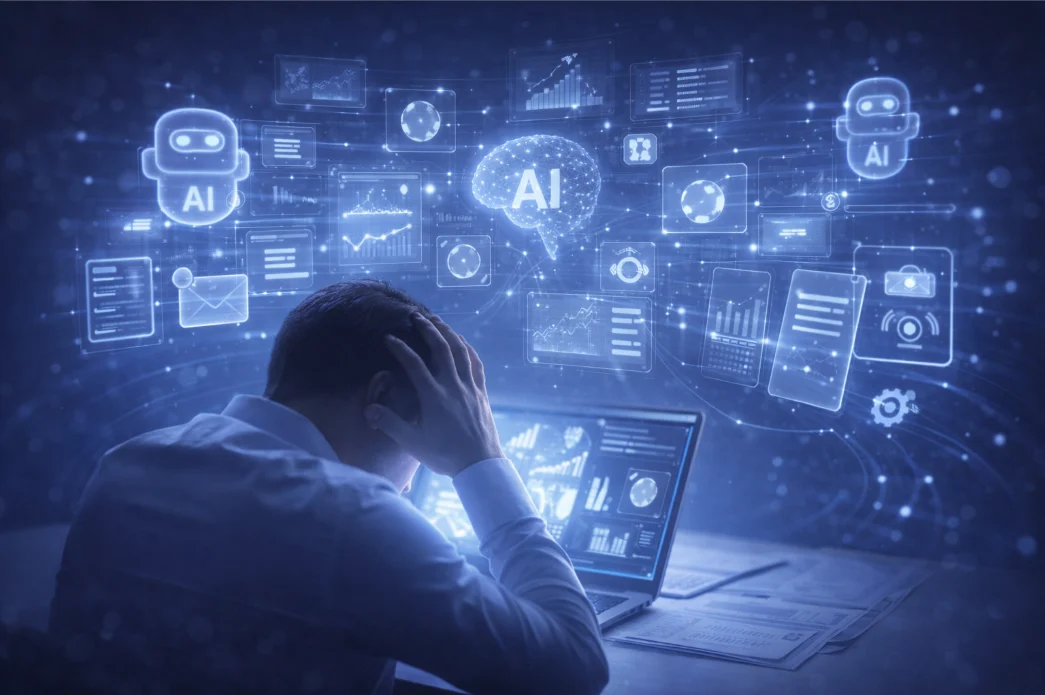
“AI makes me faster, but I’m more exhausted than ever.”
At first glance, this sounds contradictory. AI tools were introduced to reduce workload, automate repetitive tasks, and free up human creativity. From code completion and debugging to content generation and data analysis, artificial intelligence promised to make work easier and more efficient.
Yet, for many professionals, the opposite seems to be happening.
Instead of feeling relieved, workers are feeling mentally drained—spending long hours reviewing AI-generated outputs, constantly switching between tools, and racing to keep up with an ever-expanding ecosystem of new models, updates, and productivity expectations. What was meant to simplify work is, in many cases, intensifying it.
This growing sense of cognitive overload has a name now: AI fatigue.
AI fatigue describes the mental and emotional exhaustion that arises when productivity gains are achieved at the cost of sustained attention, decision-making capacity, and psychological well-being. Unlike traditional burnout, which often builds gradually from long hours, AI fatigue can appear quickly—especially among knowledge workers who interact with intelligent systems throughout the day.
And this isn’t a fringe issue.
Global surveys and workplace studies show that while AI adoption is accelerating worldwide—particularly in countries like India—many professionals are quietly experiencing increased stress, reduced deep focus, and anxiety about long-term career relevance, even as their output improves.
In this article, we take a deep, data-backed look at this emerging phenomenon. You’ll discover:
- Why AI-driven productivity gains often come with hidden mental costs
- What global and India-specific data reveal about AI fatigue in the workforce
- Real workplace examples from software engineers and other knowledge professionals
- Practical, actionable strategies to use AI effectively—without burning out
As AI becomes inseparable from modern work, understanding its human impact may be just as important as mastering the tools themselves.

1. What Is AI Fatigue?
AI fatigue refers to the mental and emotional exhaustion that arises from prolonged, high-intensity interaction with artificial intelligence systems—particularly generative AI tools such as chatbots, AI copilots, code assistants, recommendation engines, and automated decision-support workflows.
Unlike traditional workplace fatigue, which is often caused by long hours or physical strain, AI fatigue is primarily cognitive. It stems from the constant need to process, evaluate, correct, and adapt to machine-generated outputs, often across multiple tools and platforms throughout the workday.
As AI becomes embedded in everyday tasks—writing emails, generating code, analyzing data, scheduling work, and even making strategic recommendations—professionals are no longer just “doing the work.” They are increasingly supervising machines, making continuous micro-decisions that quietly drain mental energy.
Why AI Fatigue Is Different
AI systems do not eliminate decision-making—they shift it.
Instead of deciding what to do, workers must now decide:
- Whether an AI output is correct
- How much of it can be trusted
- What needs human correction
- When to override or ignore suggestions
This constant evaluation loop creates decision fatigue, especially in high-stakes roles like software engineering, consulting, finance, healthcare, and content creation.
Over time, the mental cost adds up—often without obvious warning signs.
🧠 Core Symptoms of AI Fatigue
Professionals experiencing AI fatigue commonly report the following symptoms:
- Cognitive overload
The brain struggles to process too many AI-generated options, suggestions, alerts, and outputs simultaneously, leading to mental clutter and reduced clarity. - Decision fatigue
Repeatedly judging the quality, accuracy, and relevance of AI outputs exhausts mental resources, making even simple decisions feel difficult by the end of the day. - Reduced deep focus and creativity
Continuous AI interaction encourages shallow, fragmented work patterns, making it harder to sustain concentration or engage in deep, original thinking. - Emotional detachment from work
When tasks feel increasingly machine-driven, professionals may experience a loss of ownership, satisfaction, and emotional connection to their output. - Increased anxiety despite “efficiency”
Even as productivity metrics improve, workers may feel anxious—about keeping up with AI tools, maintaining relevance, or being judged against AI-enhanced performance benchmarks.
⚠️ A Subtle but Serious Risk
AI fatigue often develops quietly. Many professionals mistake it for normal work stress or assume it’s a temporary adjustment phase. However, if left unaddressed, AI fatigue can evolve into chronic burnout, disengagement, and declining job satisfaction, undermining the very productivity gains AI is meant to deliver.
Understanding AI fatigue is the first step toward building healthier, more sustainable ways to work with intelligent systems—especially in fast-growing, AI-driven economies like India.
Why AI Productivity Gains Feel So Draining
At a surface level, AI appears to be delivering exactly what it promised: faster execution, higher output, and measurable efficiency gains. Tasks that once took hours—writing code, analyzing data, drafting content, or preparing reports—can now be completed in minutes.
Yet, many professionals report feeling more exhausted than before.
This contradiction is known as the productivity paradox of AI:
As productivity increases, mental strain increases too.
Rather than eliminating work, AI often reshapes and intensifies it—creating new cognitive demands that are less visible but equally exhausting.
🔁 The Productivity Paradox Explained
AI tools raise the ceiling of what’s possible in a workday. But as output rises, so do expectations.
Instead of freeing up time, AI frequently:
- Expands performance expectations
Faster output quickly becomes the new baseline. What was once considered “excellent speed” is now expected by default. - Compresses deadlines
If AI can generate results in minutes, timelines shrink—leaving little room for reflection, iteration, or recovery. - Adds layers of monitoring and review work
AI outputs still require human oversight. Professionals must review, edit, validate, and sometimes correct machine-generated results—often under tighter deadlines.
In effect, AI doesn’t reduce workload—it redistributes it into more mentally demanding tasks.
🧠 Key Reasons AI Feels Mentally Draining
1. Constant Context Switching Between AI Tools
Modern professionals often juggle:
- Chatbots for ideation
- Copilots for execution
- Dashboards for analytics
- Automation tools for workflows
Switching between tools forces the brain to repeatedly reorient, breaking focus and increasing cognitive switching costs—a known contributor to mental fatigue.
2. Verification Fatigue: The Hidden Cost of “Assistance”
AI outputs are rarely perfect.
Workers must:
- Check for factual errors
- Verify logic and tone
- Ensure compliance and accuracy
- Detect subtle hallucinations
This continuous evaluation creates verification fatigue, where mental energy is spent supervising AI rather than creating value directly.
3. The “Always-On” Pressure to Be Faster
AI enables instant responses—so delays feel unjustified.
This leads to:
- Reduced psychological downtime
- Pressure to respond immediately
- Difficulty disengaging from work
Over time, this erodes boundaries between focused work, shallow tasks, and rest.
4. Skill Insecurity and Career Anxiety
Even as AI boosts productivity, it introduces a persistent question:
“If AI can do this faster, what happens to my role?”
This uncertainty fuels:
- Fear of skill obsolescence
- Overworking to stay relevant
- Reluctance to step away from AI tools
Mental energy is spent not just on tasks—but on self-preservation.
⚠️ The Core Truth
AI doesn’t remove work—it changes the nature of work and often multiplies it.
Instead of reducing effort, AI shifts professionals into roles that require:
- Constant judgment
- Continuous oversight
- Faster decision-making
- Ongoing skill adaptation
Without intentional limits and redesigned workflows, these demands quietly accumulate—turning productivity gains into cognitive exhaustion.
Understanding this dynamic is critical for building sustainable AI-powered workplaces, where efficiency does not come at the cost of human well-being.
Key Facts & Statistics: What the Data Really Says (Global + India)
AI fatigue isn’t just anecdotal—it’s clearly visible in workforce data across the globe. While adoption rates and productivity metrics look impressive, a closer examination reveals a parallel rise in mental strain, workload intensity, and anxiety.
Below is what the latest global and India-focused research reveals.
🌍 Global Data: Productivity Up, Mental Load Higher
- 77% of workers say AI has increased their workload instead of reducing it
According to Upwork’s workforce research, many professionals report that AI has added new responsibilities—such as reviewing, correcting, and validating outputs—rather than eliminating tasks altogether. This highlights a growing gap between perceived efficiency and actual cognitive effort. - 39% of professionals spend more time reviewing AI-generated output than doing original work
AI assistance often shifts workers into a supervisory role. Instead of creating from scratch, employees now spend significant time verifying accuracy, tone, logic, and compliance—activities that are mentally taxing and difficult to automate. - Mentions of “fatigue” in workplace reviews jumped 41% in 2025
Glassdoor data shows a sharp rise in employees explicitly using words like fatigue, exhausted, and mentally drained when describing their work experience. Analysts link this trend partly to accelerated technology adoption, including AI-driven workflows.
🔎 What this means globally:
AI is improving output metrics, but it is also intensifying work, shortening recovery time, and increasing cognitive demands—especially for knowledge workers.
🇮🇳 India-Specific Insights: High Adoption, High Pressure
India stands out globally—not just for AI enthusiasm, but for the speed and scale of adoption, which brings its own challenges.
- 92% of Indian employees use AI tools regularly
A BCG study shows that India leads the world in workplace AI usage. From IT and startups to consulting and media, AI tools are now embedded into daily workflows across sectors. - 49% of Indian millennials fear AI-driven job displacement within the next 3–5 years
Despite high usage, nearly half of young professionals worry that AI could make their skills obsolete. This fear often leads to overworking, constant upskilling pressure, and reluctance to disconnect—key contributors to mental fatigue. - India ranks among the most optimistic yet anxious AI workforces globally
Surveys by EY and ADP reveal a paradox: Indian employees are more likely than their global peers to believe AI will improve productivity and career prospects—yet they also report elevated levels of stress, uncertainty, and performance pressure.
🔎 What this means for India:
AI is seen as an opportunity—but also as a silent stress multiplier. High ambition, competitive job markets, and long working hours amplify the mental cost of AI-driven productivity.
📌 Key Insight Box (Highlight Callout)
AI adoption is not the problem.
Unchecked AI intensity is.
Across both global and Indian data, a consistent pattern emerges:
- Productivity gains are real
- Mental and emotional costs are rising
- The human side of AI adoption is lagging behind the technology itself
This data reinforces a crucial takeaway: without thoughtful boundaries and human-centered design, AI can quietly erode well-being—even as it boosts performance.
Case Study: Software Engineers and the Rise of AI Fatigue
To understand how AI fatigue plays out in real life, consider the experience of a mid-level software engineer working in a fast-paced product team—a profile that now represents millions of professionals worldwide.
📌 The Scenario: An AI-Augmented Workday
The engineer’s daily workflow includes multiple AI-powered tools designed to boost productivity:
- AI code assistants for auto-completing functions and generating boilerplate code
- Debugging copilots that suggest fixes, optimizations, and refactors
- Documentation generators that automatically create comments, README files, and API explanations
On paper, this setup looks ideal. Tasks that once took hours can now be completed in a fraction of the time.
⚡ The Immediate Outcome: Speed Without Relief
Measured productivity improves.
- Features are delivered faster
- Code output increases
- Sprint velocity looks stronger
Yet the human experience tells a different story:
- The engineer ends the day mentally drained
- Focus feels fragmented
- Satisfaction from problem-solving declines
“I’m not coding less. I’m supervising a machine all day.”
This statement captures the core of AI fatigue in engineering roles.
🧠 Why the Mental Exhaustion Sets In
1. Line-by-Line Code Review Becomes Mandatory
AI-generated code may compile—but it isn’t always correct.
Engineers must:
- Validate logic paths
- Check for security vulnerabilities
- Ensure performance efficiency
- Maintain coding standards
This continuous scrutiny demands high cognitive vigilance, often more draining than writing code from scratch.
2. Debugging Subtle, Hard-to-Detect Errors
Unlike human mistakes, AI errors are often:
- Plausible but incorrect
- Structurally sound yet logically flawed
- Difficult to trace
Finding these issues requires deep concentration and context rebuilding—adding to mental strain.
3. Constant Tool Updates and Model Changes
AI tools evolve rapidly.
Engineers must:
- Learn new prompts and features
- Adjust workflows repeatedly
- Reassess trust levels after updates
This creates learning fatigue, where the mental cost of staying current competes with core engineering work.
🔁 The Hidden Shift in Role Identity
Traditionally, software engineers were creators and problem-solvers.
With heavy AI integration, many feel they’ve become:
- Reviewers
- Quality controllers
- Output validators
This role shift can reduce:
- Sense of mastery
- Creative fulfillment
- Emotional connection to work
Over time, this detachment compounds fatigue.
📉 The Bigger Picture
While AI tools undeniably increase short-term efficiency, this case study reveals a critical insight:
AI accelerates output—but also accelerates cognitive exhaustion when human limits aren’t considered.
Without redesigned workflows and clear boundaries, software engineers risk trading creative satisfaction for mechanical supervision, a trade-off that fuels AI fatigue across the tech industry.
The Psychology Behind AI Fatigue
AI fatigue is not just a workplace trend—it is rooted in well-established psychological and cognitive science principles. When humans interact intensively with intelligent systems, the brain is forced to operate in ways it was not evolutionarily designed for: constant evaluation, rapid switching, and sustained vigilance.
Several key psychological mechanisms explain why AI-driven productivity can feel mentally exhausting.
🧩 1. Cognitive Load Theory: When the Brain Is Overwhelmed
Cognitive Load Theory explains how the human brain processes information using limited working memory. When this capacity is exceeded, performance declines and mental exhaustion sets in.
AI tools significantly increase:
- The volume of information presented
- The number of options and suggestions
- The speed at which decisions must be made
Instead of focusing on one task, professionals must now:
- Interpret AI-generated outputs
- Compare alternatives
- Understand context the AI may have missed
- Integrate machine suggestions with human judgment
This constant influx overwhelms working memory, leading to:
- Mental fog
- Slower thinking despite faster tools
- Reduced ability to engage in deep, analytical work
In short, AI accelerates information faster than the human brain can comfortably process it.
🔄 2. Decision Fatigue: The Cost of Endless Evaluation
AI does not eliminate decisions—it multiplies them.
Every AI interaction creates a micro-decision:
- Is this output accurate?
- Should I accept or modify it?
- Is this recommendation appropriate?
- Do I trust this result?
Over a full workday, these micro-decisions accumulate into decision fatigue—a state where mental energy for judgment is depleted.
As decision fatigue increases:
- Error rates rise
- Risk aversion increases
- Creativity declines
- Emotional regulation weakens
This explains why professionals often feel irritable, unfocused, or mentally “done” by the end of an AI-heavy day—even if tasks were completed quickly.
🧍 3. Loss of Autonomy and Psychological Ownership
Another powerful contributor to AI fatigue is the loss of autonomy.
Psychological research consistently shows that humans derive motivation and satisfaction from:
- Control over their work
- A sense of authorship
- Mastery through effort
When AI systems:
- Suggest how tasks should be done
- Generate large portions of output
- Influence decisions continuously
Workers may feel like operators rather than creators.
This reduced sense of ownership can lead to:
- Emotional detachment from work
- Lower intrinsic motivation
- Decreased job satisfaction
Over time, this detachment becomes mentally draining—even if productivity metrics look strong.
🧠 4. Hypervigilance and Trust Monitoring
AI fatigue also stems from a state of constant low-level vigilance.
Because AI outputs are:
- Often confident but occasionally wrong
- Fluent yet sometimes misleading
Users remain in a near-constant state of alertness—monitoring for errors, hallucinations, or misjudgments.
This mental posture mirrors cognitive hypervigilance, a condition associated with:
- Elevated stress levels
- Difficulty relaxing
- Faster mental depletion
The brain never fully “rests” when interacting with AI—it stays on guard.
⚠️ Health Impacts: What Occupational Research Warns
According to WHO and occupational mental health studies, prolonged cognitive overload—especially without adequate recovery—significantly increases the risk of:
- Anxiety disorders
Constant performance pressure and uncertainty heighten stress responses. - Sleep disturbances
An overactivated mind struggles to disengage, leading to poor sleep quality and insomnia. - Long-term burnout
Sustained cognitive strain without emotional reward accelerates burnout far faster than physical exhaustion.
Importantly, these effects can appear even when working hours remain unchanged, making AI fatigue harder to detect and address.
🔍 Key Insight Callout
The brain experiences AI overload long before productivity metrics show decline.
This is why AI fatigue often goes unnoticed—until engagement drops, creativity suffers, or burnout sets in.
Understanding the psychology behind AI fatigue is essential for designing human-centered AI workflows, where intelligence augmentation supports—not overwhelms—the human mind.
How AI Fatigue Shows Up at Work
AI fatigue rarely announces itself clearly. Unlike traditional burnout—which often builds slowly through long hours and visible exhaustion—AI fatigue tends to surface subtly, embedded in everyday work behaviors and thought patterns.
Many professionals continue to hit productivity targets, meet deadlines, and appear “high-performing” on the surface. Internally, however, the signs of mental strain begin to accumulate.
Recognizing these warning signals early is critical.
⚠️ Common Warning Signs of AI Fatigue
1. Feeling Busy but Unfulfilled
Professionals experiencing AI fatigue often report:
- Completing more tasks than ever
- Moving quickly from one output to the next
- Yet feeling little satisfaction or sense of accomplishment
Work starts to feel mechanical rather than meaningful. The speed of AI-driven execution leaves little room for reflection, creativity, or pride in outcomes.
2. Difficulty Focusing Without AI Support
Another early indicator is dependence-related focus loss.
Individuals may notice:
- Struggling to start tasks without AI prompts
- Reduced confidence in independent thinking
- Slower problem-solving when AI tools are unavailable
This can create anxiety about one’s own cognitive abilities and reinforce over-reliance on AI systems.
3. Emotional Detachment From Outcomes
As AI takes on more of the “doing,” professionals may feel:
- Less ownership over results
- Reduced emotional investment in success or failure
- A sense that outcomes are driven by systems, not skills
This detachment weakens intrinsic motivation and accelerates mental exhaustion over time.
4. Over-Reliance on AI for Thinking and Judgment
AI fatigue often coincides with cognitive offloading gone too far.
Warning behaviors include:
- Accepting AI suggestions without critical evaluation
- Using AI for routine decisions that once required human judgment
- Avoiding independent analysis to save mental energy
Ironically, this reliance can worsen fatigue, as trust monitoring and correction remain necessary.

🧠 Secondary Signs Managers Often Miss
Beyond individual symptoms, AI fatigue can manifest at the team level:
- Declining creativity and innovation
- Shorter attention spans during meetings
- Increased irritability or disengagement
- Reduced willingness to experiment or take initiative
Because productivity metrics may remain high, these changes are often misattributed to attitude or motivation issues rather than cognitive strain.
🔔 Quick Fact (Highlight Callout)
AI fatigue often appears long before traditional burnout.
By the time burnout is visible—through absenteeism, disengagement, or performance drops—the mental toll of AI overload has often been accumulating for months.
📌 Why Early Detection Matters
When AI fatigue goes unrecognized:
- Creativity declines before output does
- Engagement erodes quietly
- Burnout risk increases exponentially
Identifying these early signs allows individuals and organizations to redesign workflows, reset expectations, and restore healthy boundaries—before productivity gains turn into long-term losses.
Here’s a more detailed, clearer, and SEO-optimized version of the section while keeping the same comparison-table format, just with richer explanations added inside each cell:
AI Fatigue vs Traditional Burnout
| Aspect | Traditional Burnout | AI Fatigue |
| Primary Cause | Prolonged overwork, excessive hours, emotional strain, and sustained pressure over time. | Continuous cognitive overload from frequent interaction with AI systems, constant evaluation, and rapid decision-making. |
| Pace of Onset | Develops gradually, often over months or years, as stress accumulates slowly. | Appears rapidly, sometimes within weeks, especially in AI-intensive roles. |
| Main Trigger | Long working hours, lack of rest, high emotional labor, and persistent workload imbalance. | Constant AI interaction, including reviewing outputs, context switching, and supervising automated systems. |
| Type of Fatigue | Emotional, physical, and mental exhaustion combined. | Primarily mental and cognitive exhaustion, with subtle emotional effects. |
| Visibility | Often visible through absenteeism, disengagement, or performance decline. | Largely invisible, as productivity metrics may remain high. |
| Impact on Productivity | Productivity usually drops noticeably before intervention. | Productivity may increase or stay stable while mental strain worsens. |
| Common Misdiagnosis | Recognized as burnout or stress-related exhaustion. | Often mistaken for normal work stress or “adjustment” to new tools. |
| Typical Solution | Time off, reduced workload, vacations, or role changes. | Redesigning AI usage: boundaries, fewer tools, better workflows, and human-centered AI practices. |
| Long-Term Risk if Ignored | Chronic burnout, disengagement, and health issues. | Accelerated burnout, loss of creativity, and reduced cognitive resilience. |
🔍 Key Insight Callout
You can recover from burnout with rest.
You can only recover from AI fatigue by changing how you work with AI.
This distinction is critical. Treating AI fatigue like traditional burnout—by offering time off alone—fails to address the root cause. Sustainable performance requires intentional AI integration, not just recovery time.
Expert Opinions
McKinsey (Workforce of the Future):
“AI productivity gains must be balanced with human sustainability metrics.”
WHO Workplace Mental Health Reports:
“Technology-driven cognitive overload is a growing occupational risk.”
Why AI Fatigue Hits India Differently
India is often celebrated as a global leader in AI adoption—and rightly so. From IT services and startups to consulting, fintech, and media, AI tools are being integrated into daily workflows at an unprecedented pace. However, this rapid adoption is also creating unique pressures that make AI fatigue more intense and more widespread in the Indian workforce.
🚀 1. Exceptionally High AI Adoption Rates
India has one of the highest workplace AI adoption rates in the world. Surveys by global consulting firms show that a vast majority of Indian professionals use AI tools regularly—often across multiple functions in the same role.
What this means in practice:
- AI is not optional; it’s expected
- Professionals must stay constantly updated on new tools and models
- Falling behind on AI usage can feel like falling behind professionally
This constant exposure increases cognitive load far faster than in regions with slower adoption.
🏁 2. Intensely Competitive Job Markets
India’s job market is:
- Large
- Highly competitive
- Skill-driven
In sectors like IT, software engineering, consulting, and digital marketing:
- Workers compete globally
- Performance comparisons are frequent
- AI-enhanced productivity becomes the new benchmark
As a result, many professionals:
- Overuse AI to stay competitive
- Work longer hours to “outperform”
- Avoid disconnecting for fear of losing relevance
This creates continuous performance pressure, even when AI boosts output.
⏰ 3. Long Working Hours and Blurred Boundaries
India already ranks high in terms of average working hours, especially in urban, white-collar roles. AI tools—by enabling faster responses and 24/7 availability—often blur the line between work and rest even further.
Common realities include:
- Late-night AI-assisted work
- Weekend catch-ups justified by “quick AI help”
- Always-on availability across time zones
This leaves limited recovery time for the brain, accelerating mental exhaustion.
🧠 4. Cultural Emphasis on Hustle and Output
India’s professional culture often values:
- Hard work over rest
- Output over process
- Speed over sustainability
When AI enters this environment, it amplifies existing norms:
- Faster work becomes expected, not exceptional
- Downtime feels unproductive
- Mental fatigue is rarely discussed openly
As a result, AI fatigue is often normalized or ignored, rather than addressed.
⚠️ The Pressure Cooker Effect
All these factors combine to create what experts describe as a “pressure cooker” environment:
High AI-driven output expectations + intense competition + long working hours + limited recovery time
The result is a workforce that appears highly productive on the surface—but is quietly accumulating cognitive stress, anxiety, and disengagement underneath.
📌 Why This Matters
If AI fatigue in India goes unaddressed:
- Burnout rates could rise faster than global averages
- Creativity and innovation may decline
- The long-term sustainability of AI-led growth could be threatened
Recognizing India’s unique context is essential for designing AI adoption strategies that prioritize both productivity and human well-being.
How to Prevent AI Fatigue (Without Losing Productivity)
Preventing AI fatigue isn’t about rejecting AI—it’s about using it intentionally. Sustainable productivity comes from designing workflows where AI supports human thinking rather than overwhelming it.
Below are practical, evidence-backed strategies for both individuals and organizations.
👤 For Individuals: Build Healthier AI Habits
⏳ 1. Limit AI Usage Windows
Instead of keeping AI tools open all day:
- Designate specific time blocks for AI-assisted tasks
- Avoid constant, reactive AI usage
- Batch similar AI tasks together
This reduces context switching and gives the brain predictable periods of focus.
🧠 2. Use AI for Support, Not Thinking
AI should:
- Accelerate execution
- Assist with research or drafting
- Reduce repetitive work
But it should not replace core thinking. Start tasks independently, then use AI to refine—not generate—your ideas. This preserves cognitive strength and confidence.
🔕 3. Schedule Deep-Work Time Without AI
Deliberately plan:
- AI-free coding sessions
- Writing or analysis blocks without AI prompts
- Problem-solving time using only human reasoning
These periods rebuild focus, creativity, and mental stamina—skills that erode with over-reliance on automation.
📚 4. Learn AI Fundamentals to Reduce Anxiety
A major driver of AI fatigue is uncertainty.
Understanding:
- What AI can and cannot do
- Where it fails
- Why it makes mistakes
Reduces fear, improves trust calibration, and lowers mental vigilance. Knowledge turns AI from a threat into a tool.
🏢 For Companies: Design Human-Centered AI Workflows
🧭 1. Set Clear AI Usage Boundaries
Organizations should:
- Define where AI is appropriate
- Clarify tasks that require human judgment
- Discourage “AI everywhere” culture
Boundaries prevent tool overload and normalize thoughtful AI use.
📊 2. Measure Well-Being—Not Just Output
Traditional productivity metrics miss cognitive strain.
Companies should track:
- Engagement and focus
- Error rates and rework
- Burnout and stress indicators
Sustainable performance requires human health metrics alongside efficiency.
🎓 3. Provide AI Literacy Training
AI fatigue decreases when employees understand:
- How AI works
- How to prompt effectively
- How to detect errors and bias
Training reduces uncertainty, builds confidence, and lowers cognitive load.
✋ 4. Normalize Human-Only Workflows
Not every task needs AI.
Organizations should:
- Encourage AI-free brainstorming
- Support manual review for critical decisions
- Reward original thinking—not just speed
This restores autonomy, ownership, and job satisfaction.
🔑 Key Insight Callout
The goal isn’t maximum AI usage—it’s optimal AI usage.When individuals and organizations treat AI as a tool rather than a default, productivity becomes sustainable instead of exhausting.
FAQs Section
1. Is AI fatigue a medical or clinical condition?
No, AI fatigue is not yet classified as a medical or psychiatric disorder. However, psychologists and workplace health experts increasingly recognize it as a serious occupational mental health risk.
It sits alongside concepts like digital fatigue, decision fatigue, and cognitive overload. If ignored over time, AI fatigue can escalate into clinical burnout, anxiety disorders, or depression, according to occupational health research.
2. Can AI fatigue reduce productivity in the long run?
Yes—significantly. While AI boosts short-term efficiency, long-term exposure without boundaries can:
- Reduce deep thinking and creativity
- Lower problem-solving accuracy
- Increase mental errors and rework
- Cause disengagement and presenteeism
Ironically, teams chasing AI-driven productivity often experience declining output quality after 6–12 months due to mental exhaustion.
3. How widespread is AI fatigue globally?
AI fatigue is becoming global and systemic, especially in knowledge-based economies. Surveys across the US, Europe, and Asia show:
- Employees feel pressure to match AI speed
- Work expectations rise immediately after AI adoption
- “Efficiency gains” are rarely matched with workload reduction
This makes AI fatigue less of an individual issue and more of a structural workplace problem.
4. Is AI fatigue more severe in India than in other countries?
Yes, in many cases. India faces a unique convergence of risk factors:
- Extremely high AI adoption rates
- Intense competition for tech and white-collar jobs
- Longer working hours than most OECD countries
- Cultural pressure to constantly upskill
This means Indian professionals often use AI not to reduce work, but to survive performance expectations, accelerating fatigue.
5. How is AI fatigue different from traditional burnout or tech burnout?
AI fatigue differs in origin and speed:
- Traditional burnout develops slowly from emotional stress and overwork
- AI fatigue emerges rapidly from constant mental evaluation and supervision of AI systems
AI fatigue is primarily cognitive, not emotional—at least initially. If unresolved, it frequently transforms into full burnout.
6. Which job roles are most vulnerable to AI fatigue?
Roles with continuous AI interaction are at the highest risk, including:
- Software engineers and developers
- Data analysts and BI professionals
- Consultants, auditors, and strategists
- Content creators, marketers, and SEO professionals
- Product managers and UX designers
The common factor is decision-heavy work amplified by AI suggestions.
7. Does AI fatigue affect creativity and innovation?
Yes. AI fatigue reduces creative capacity by:
- Encouraging surface-level thinking
- Replacing exploration with optimization
- Discouraging experimentation
When professionals rely too heavily on AI-generated patterns, original thinking declines—especially in design, writing, strategy, and problem-solving roles.
8. Can AI fatigue impact mental health and sleep?
Yes. Sustained AI fatigue is linked to:
- Mental restlessness even after work hours
- Difficulty sleeping due to cognitive overstimulation
- Increased anxiety about performance and relevance
- Emotional numbness toward work outcomes
WHO-backed occupational studies warn that prolonged cognitive overload disrupts sleep cycles and stress regulation.
9. Is AI fatigue caused by bad AI tools or poor implementation?
Mostly poor implementation, not bad tools. Even advanced AI systems can cause fatigue when:
- Employees are expected to be “always faster”
- AI output must be constantly reviewed
- There are no norms for when not to use AI
The problem lies in how organizations redesign work, not the technology itself.
10. Can AI literacy and training reduce AI fatigue?
Absolutely. AI literacy:
- Reduces fear and uncertainty
- Helps users trust outputs appropriately
- Prevents over-verification
- Restores a sense of control and autonomy
People who understand AI limitations report lower stress and higher confidence than those who treat AI as an unpredictable black box.
11. How can companies detect AI fatigue early among employees?
Early indicators include:
- Faster output but declining engagement
- Rising quality-control effort
- Complaints of “mental exhaustion” despite efficiency
- Overdependence on AI for basic decisions
Organizations should track well-being metrics alongside productivity, not after performance drops.
12. Is AI fatigue a short-term transition issue or a long-term risk?
AI fatigue is not temporary. As AI becomes deeply embedded in workflows, it will remain a persistent workplace challenge unless organizations:
- Redesign roles
- Set AI boundaries
- Preserve human-only thinking time
Companies that ignore this risk may face higher attrition, disengagement, and invisible productivity losses.
13. What is the healthiest way to use AI without burning out?
The most effective strategy is intentional AI usage, which includes:
- Using AI as an assistant, not a decision-maker
- Scheduling AI-free deep work sessions
- Limiting simultaneous AI tools
- Valuing human judgment over speed
AI should support cognition—not replace it.
14. Will AI fatigue become a major HR and policy issue in the future?
Yes. Experts predict AI fatigue will:
- Influence future workplace wellness policies
- Shape AI governance and ethical frameworks
- Become part of ESG and employee well-being metrics
Forward-looking organizations are already integrating human sustainability into AI strategy.
Summary
- AI boosts speed—but drains mental energy
While AI tools significantly improve productivity, many professionals experience increased cognitive load, constant context switching, and decision fatigue, leading to mental exhaustion rather than relief. - AI fatigue is a growing but underreported workplace issue
Unlike traditional burnout, AI fatigue stems from supervising, verifying, and interacting with intelligent systems all day—an issue now being flagged by engineers, researchers, and HR leaders worldwide. - Global and Indian data reveal a productivity paradox
Studies show high AI adoption (especially in India), yet a large percentage of workers report higher stress, longer effective work hours, and anxiety about job security despite efficiency gains. - Knowledge workers are the most affected
Software engineers, analysts, consultants, and content professionals often spend more time reviewing AI outputs than creating original work, which reduces deep focus and increases mental strain. - Unchecked AI use can hurt long-term performance and well-being
Continuous cognitive overload may reduce creativity, decision quality, and emotional engagement at work—making AI fatigue an early warning sign of deeper burnout and disengagement.
Sustainable AI use is the real competitive advantage
The future of work lies in setting boundaries, improving AI literacy, and designing human-centered workflows where AI supports thinking rather than replacing it.

Conclusion
AI is not the enemy.
In fact, artificial intelligence has already proven its value—accelerating workflows, unlocking insights, and transforming how modern work gets done.
But unchecked AI usage is not progress.
It is pressure disguised as efficiency.
Across industries, professionals are discovering an uncomfortable truth:
while machines are getting faster, humans are getting more exhausted. The constant need to supervise AI outputs, switch between tools, validate decisions, and keep up with nonstop innovation has created a silent mental tax—one that rarely appears on productivity dashboards but shows up clearly in focus, motivation, and well-being.
The future of work will not be defined by how fast machines can generate answers.
It will be defined by how sustainably humans can think, decide, and create alongside them.
Organizations that treat AI purely as a speed multiplier risk burning out their most valuable asset—the human mind. In contrast, companies and individuals who design human-centered AI workflows—with clear boundaries, intentional usage, and protected deep-thinking time—will gain not just efficiency, but resilience.
AI should amplify human intelligence, not replace it.
Productivity should feel empowering, not draining.
And real progress will come when success is measured not only in output per hour—but in clarity, creativity, and long-term human sustainability.
Because in the end, the strongest workplaces won’t be the ones with the smartest machines—
they’ll be the ones that still protect the people using them.
References & Sources
🌍 Global Institutions & Research Bodies
- World Health Organization (WHO) – Workplace Mental Health & Burnout
https://www.who.int/teams/mental-health-and-substance-use/workplace-mental-health - International Labour Organization (ILO) – Mental Health at Work
https://www.ilo.org/global/topics/safety-and-health-at-work/areasofwork/workplace-health-promotion/WCMS_108557/lang–en/index.htm
🧠 Consulting & Future of Work Reports
- McKinsey Global Institute – The Future of Work & AI Productivity
https://www.mckinsey.com/featured-insights/future-of-work - BCG (Boston Consulting Group) – AI Adoption & Workforce Impact Reports
https://www.bcg.com/publications/collections/artificial-intelligence - Deloitte – Human Capital Trends & AI at Work
https://www2.deloitte.com/global/en/insights/focus/human-capital-trends.html
📊 Enterprise, Workforce & Employee Sentiment Data
- EY (Ernst & Young) – Work Reimagined Survey
https://www.ey.com/en_gl/workforce/work-reimagined - Gallup – Employee Engagement, Burnout & Workplace Well-being
https://www.gallup.com/workplace/349484/state-of-the-global-workplace.aspx - ADP Research Institute – Global Workforce Trends
https://www.adpresearch.com
💼 Tech, Freelance & Productivity Platforms
- Upwork – AI Productivity & Workforce Research
https://www.upwork.com/research - Microsoft Work Trend Index – AI, Copilots & Cognitive Load
https://www.microsoft.com/worklab/work-trend-index
🏢 Workplace Reviews & Cultural Signals
- Glassdoor – Workplace Trends, Burnout & Employee Reviews
https://www.glassdoor.com/research - LinkedIn Economic Graph – Jobs, Skills & AI Impact
https://economicgraph.linkedin.com
🇮🇳 India-Focused Business & Tech Coverage
- Economic Times – AI, IT Workforce & Corporate Culture
https://economictimes.indiatimes.com/tech - NASSCOM – AI, IT Services & Talent Reports (India)
https://nasscom.in/knowledge-center - Ministry of Electronics & IT (MeitY), Government of India – AI & Digital Workforce
https://www.meity.gov.in
📈 Market & Industry Data (Optional for Charts)
- Statista – AI Market, Adoption & Workforce Statistics
https://www.statista.com/markets/424/topic/539/artificial-intelligence/
