









Estimated Reading Time: 20-24 minutes (4,111 words)
Introduction
House‑hunting in India has undergone a radical transformation over the past decade. Gone are the days when finding a home meant spending countless weekends visiting brokers’ offices, flipping through newspaper classifieds, or driving across unfamiliar localities in search of “for sale” or “for rent” signs. Today, the process has largely moved online, driven by the rise of smartphone apps, digital property listings, virtual tours, and AI-powered search tools.
The shift is powered by several factors:
- Smartphone penetration: India now has over 1.1 billion mobile subscribers, with smartphones as the primary device for online activity. This has made property search apps widely accessible, even in Tier‑2 and Tier‑3 cities. (TechSci Research, 2025)
- Urbanization & migration: Rapid growth in urban centers like Bengaluru, Mumbai, and Pune has increased demand for apartments, rentals, and affordable housing, creating a need for quick, efficient search tools.
- Hybrid & remote lifestyles: With remote work and hybrid jobs becoming mainstream post-2020, many professionals and NRIs are looking for homes in cities they’ve never lived in before — making virtual tours and online listings crucial.
- Transparency & convenience: Property apps now offer verified listings, AI-based price estimates, and legal documentation assistance, helping buyers and renters make smarter, faster decisions.
However, the explosive growth of PropTech also brings challenges. With dozens of property apps available today, it can be overwhelming to figure out which platforms are genuinely helpful and trustworthy — and which are just cluttered with outdated listings or spammy ads.
In this blog, we aim to cut through the noise:
- Review the top property search apps in India (2025) based on features, usability, and credibility.
- Highlight what makes a property app truly effective — from verified listings and smart filters to virtual tours and market analytics.
- Guide buyers, renters, and investors on which app best suits their needs.
- Provide actionable tips to shortlist, verify, and select properties efficiently, saving time, money, and unnecessary stress.
Whether you’re a first-time homebuyer, a renter looking for convenience, or an investor seeking high rental yields, this guide will help you navigate India’s booming online property market confidently and strategically.
Why Online Property Search Is Booming in India
The Indian real estate market is growing at a rapid pace, driven by both economic growth and technological adoption. According to International Real Estate Times, the overall real estate sector — covering residential, commercial, and mixed-use properties — is projected to grow at a CAGR of ~10.5% between 2025–2033. This growth is fueled by rising urbanisation, increasing disposable incomes, and major infrastructure initiatives like metro expansions, expressways, and “Smart City” projects. The demand is especially strong in metros and Tier-2/Tier-3 cities, where migration for jobs and education is high.
The PropTech Revolution
India’s real estate sector is undergoing a digital transformation, popularly referred to as PropTech (Property Technology). As of 2025:
- The Indian PropTech market is estimated at USD 1.66 billion, expected to reach USD 4.29 billion by 2031, growing at a CAGR of ~16.95%. (Let’s Rentz Blog)
- PropTech platforms include property search apps, virtual tour services, AI-based price calculators, and real-time analytics tools, making property discovery faster, smarter, and more transparent.
- Digitisation allows buyers, renters, and investors to compare properties, estimate market prices, and access verified listings without physically visiting multiple sites.
Changing Consumer Behaviour
The way Indians search for property has shifted dramatically:
- Over 80% of prospective homebuyers and renters start their property search online, primarily through apps and portals.
- The trend is driven by smartphone penetration, with over 900 million mobile users in India in 2025.
- Buyers are increasingly looking for convenience, transparency, and speed, making apps and digital listings the preferred first step. (Let’s Rentz Blog)
Emerging Demand Patterns
Online property search is not just about buying anymore:
- There is rising demand for rentals, co-living spaces, and affordable housing, particularly among young professionals, students, and migrant workers. (Global Risk Community)
- NRIs and remote workers increasingly rely on virtual tours and verified listings to explore homes in cities they haven’t lived in before.
- Investors use digital platforms to analyze price trends, rental yields, and emerging localities before committing capital.
Key Takeaway
Online property search apps have evolved from being “nice-to-have” tools to essential platforms for home-seekers and investors. In a dynamic and digital-first real estate market, the right property app can save weeks of time, reduce financial risks, and provide actionable insights that traditional methods simply cannot match.
What Makes a Great Property Search App — Key Features to Look For
Choosing the right property search app can dramatically simplify your home-hunting journey. In 2025, with dozens of apps competing for attention, it’s essential to know which features truly matter. Here’s a detailed checklist to evaluate any property app before committing your time or money:
✅ 1. Large Inventory & Wide Geographic Coverage
- A strong app should offer listings across metros, Tier‑2, and Tier‑3 cities, covering apartments, plots, independent houses, commercial spaces, and rentals.
- For example, MagicBricks and 99acres offer listings in over 1,200 cities and towns in India, making them ideal for buyers and renters seeking options beyond just metros.
- Why it matters: A wider inventory increases your chances of finding properties that match your budget, preferred locality, and specific needs without hopping between multiple platforms.
✅ 2. Verified Listings with Transparency
- Verified listings indicate that the app has cross-checked ownership, legal documentation, and property status, often including RERA compliance, occupancy certificates, and approved floor plans.
- Clear, high-resolution photos and floor plans reduce the risk of surprises during site visits. Apps like Housing.com and NoBroker prioritize verified listings, which enhances trust.
- Why it matters: Avoid wasting time on fake or outdated ads and reduce the risk of fraudulent transactions.
✅ 3. Advanced Search Filters & Smart Recommendations
- Modern apps use AI and machine learning to recommend properties based on your preferences: budget, locality, amenities, commute time, and property type.
- Filters often include number of bedrooms, square footage, furnishing status, proximity to schools or workplaces, rental yields, and resale history.
- Why it matters: Smart filters save hours of scrolling and ensure you only see properties that fit your exact requirements.
✅ 4. Virtual Tours, Photos, Videos & 3D Floor Plans
- Apps now provide 360-degree virtual tours, walkthrough videos, and 3D floor plans, enabling buyers to assess layout and space without a physical visit.
- Particularly useful for NRIs, remote workers, or individuals relocating to a new city.
- Why it matters: Reduces travel time and allows early filtering of properties, so only serious candidates are shortlisted for site visits.
✅ 5. User-Friendly UI & Mobile-Friendly Performance
- The app should load quickly, have intuitive navigation, and support responsive design for both mobile and tablet devices.
- Features like one-tap contact to owners, map-based search, and saved favourites enhance usability.
- Why it matters: A clunky interface wastes time and may lead to missed opportunities in a competitive real estate market.
✅ 6. Additional Services & Tools
- Many apps offer value-added services:
- Home-loan assistance and EMI calculators to estimate affordability.
- Legal verification or title check guidance.
- Direct contact with owners or brokers.
- Brokerage-free listings or premium visibility for sellers.
- Home-loan assistance and EMI calculators to estimate affordability.
- Why it matters: These services reduce transaction friction, giving users an end-to-end solution on a single platform.
✅ 7. Market Data & Analytics
- Top apps provide property price trends, neighbourhood analytics, comparable sales, and rental yield estimates.
- Examples: MagicBricks’ PropWorth tool predicts property valuation, while 99acres offers heatmaps of price trends in different localities.
- Why it matters: Investors and buyers can make data-driven decisions, optimizing purchase timing and location for maximum ROI.
✅ 8. Trust, Reviews & User Feedback
- Verified user reviews, ratings, and transparent broker vs owner distinction help gauge the credibility of listings.
- Apps that allow feedback on property condition, responsiveness of the seller, and overall experience help future users make informed choices.
- Why it matters: Real user insights often reveal hidden pros/cons that photos or descriptions may not cover, helping avoid costly mistakes.
Top 5 Property Apps in India (2025)
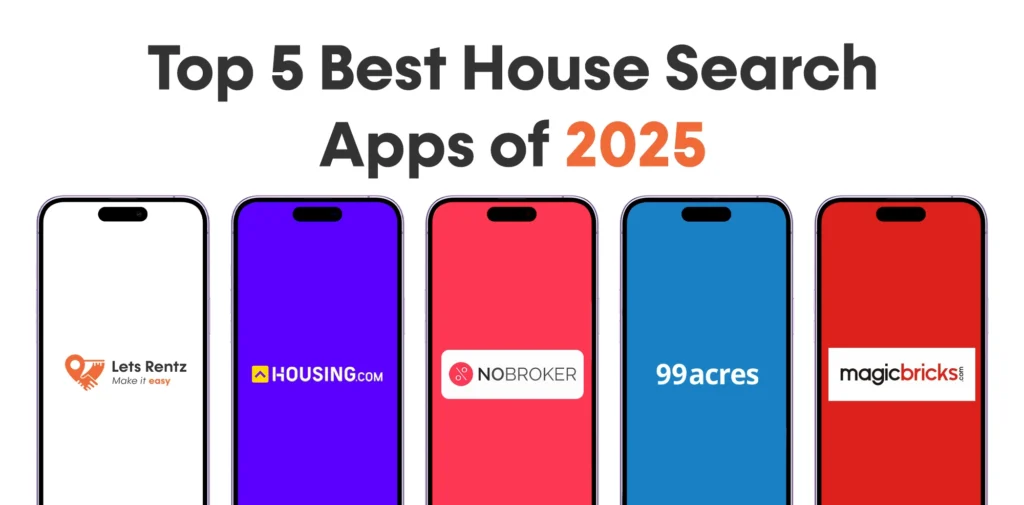
Here’s a deep dive into the five top apps that every home‑seeker in India should know about (in no particular order).
MagicBricks
- Overview: Market leader and one of the most downloaded real-estate apps in India. It’s widely trusted by buyers, renters, and investors alike. (Let’s Rentz Blog, Wikipedia)
- Inventory: Extensive listings from budget flats to luxury homes across metros, Tier‑2, and Tier‑3 cities. (LinkedIn)
- Key Features:
- Instant property valuation using PropWorth (~98% price accuracy).
- AI-assisted property recommendations.
- Advanced search filters for locality, amenities, price, property type, and more.
- Virtual tours, 3D visualizations, and high-resolution property photos.
- EMI & home-loan calculators, with multiple bank partnerships.
- Direct chat with owners and brokers. (Let’s Rentz Blog, Decentro)
- Instant property valuation using PropWorth (~98% price accuracy).
- Additional Perks: MB‑Prime for direct owner listings (brokerage‑free), priority visibility for sellers, and integration with financing services.
- Best For: Buyers seeking variety, first-time home‑buyers, users looking for owner-listed or brokerage-free properties, and those valuing valuation & analytics tools.
NoBroker
- Overview: Known for its “zero-brokerage” model, which helps reduce or eliminate brokerage costs — a major benefit for renters and first-time buyers. (Ghar.tv)
- Inventory: Listings across major cities, suitable for both rentals and purchases, with a focus on direct owner deals.
- Key Features:
- 360-degree virtual tours for remote property assessment.
- AI-powered property recommendations.
- Digital rental agreements.
- Home-loan assistance and EMI calculators.
- Direct chat/contact with property owners.
- 360-degree virtual tours for remote property assessment.
- Cost-Saving Example: On a ₹50 lakh property, using NoBroker can save tens of thousands of rupees in brokerage.
- Best For: Renters, tenants, small-budget buyers, first-time renters, or anyone preferring direct owner contact without intermediaries.
Housing.com
- Overview: Focuses on verified listings, legal transparency, and a smooth user experience, ideal for serious buyers who value documentation and clarity. (Ghar.tv)
- Inventory: Strong coverage in metro cities and select Tier‑2 cities; offers residential and commercial listings.
- Key Features:
- Map-based property searches with locality insights.
- Neighbourhood info: schools, hospitals, transport connectivity.
- Property photos, 3D/VR tours.
- EMI calculators and home-loan pre-approval.
- Map-based property searches with locality insights.
- Best For: Buyers prioritizing transparency, verified documentation, and locality-based searches, rather than just price.
99acres
- Overview: Well-known for urban apartments and resale properties, with strong analytics for buyers and investors. (LinkedIn)
- Inventory: Extensive resale flats and apartments in metros and Tier‑1 cities, including upcoming projects.
- Key Features:
- Price trends, rental yields, and heatmaps for data-driven decisions.
- Detailed property analytics and comparative insights.
- Regularly updated interface with a large property inventory for resale and lease. (Ghar.tv)
- Price trends, rental yields, and heatmaps for data-driven decisions.
- Best For: Investors, buyers seeking resale apartments, urban buyers focused on capital appreciation or rental yield, and those exploring multiple cities.
NayaPurana.in
- Overview: A rising platform offering free listings for sellers and landlords, with unlimited property postings for rent or sale. (NayaPurana.in)
- Inventory: Pan-India coverage including metros and Tier‑2/3 cities; ideal for niche and budget properties.
- Key Features:
- AI-powered property search and lead generation.
- Direct communication between buyers/renters and owners/landlords.
- Free posting for sellers, increasing the likelihood of finding hidden or less-publicized listings.
- AI-powered property search and lead generation.
- Best For: Landlords seeking exposure, budget-conscious buyers/renters, and property seekers in Tier‑2 and Tier‑3 cities where bigger portals may have limited coverage.
Detailed Comparison Table
| App | Strengths | Potential Weaknesses / For Whom Less Suitable |
| MagicBricks | – Broad inventory covering metros, Tier‑2, Tier‑3 cities.- Strong search filters, AI recommendations, and analytics tools (PropWorth, market trends, rental yields).- Offers brokerage-free owner listings via MB-Prime.- Suitable for both purchase and rental, including luxury and budget options. | – High competition on listings; some properties may be outdated or sold off-market.- Users occasionally report spam calls from brokers despite owner-direct listings.- May be overwhelming for beginners due to feature-rich interface. (Decentro) |
| NoBroker | – Zero-brokerage model eliminates commission costs — great for rentals and small-budget purchases.- Direct contact with owners ensures transparent communication.- Simple, mobile-friendly UI, with virtual tours and rental agreements. | – Fewer premium or luxury listings, making it less ideal for high-end buyers.- May have limited coverage in certain Tier‑3 cities.- Focused more on rentals than resale investment properties. |
| Housing.com | – Emphasis on verified listings, legal transparency, and documentation compliance.- Map-based and neighbourhood/amenity data helps buyers assess locality suitability.- Offers EMI calculators and home-loan pre-approval. | – Inventory smaller than MagicBricks or 99acres in some regions.- May focus more on structured projects than independent or resale properties.- Less suitable for users prioritizing wide variety of listings. |
| 99acres | – Strong analytics and price trend tools for investors.- Focus on resale apartments and urban listings, good for ROI or rental yield tracking.- Regularly updated interface with large coverage in metros. | – New project launches may be slower to appear.- Less focus on plots, land, or affordable housing options.- May not be ideal for first-time buyers seeking broker-free or budget properties. |
| NayaPurana.in | – Free listings for sellers, helping landlords and budget-conscious buyers.- Pan-India coverage, including Tier‑2 and Tier‑3 cities often underserved by big portals.- AI-powered property search and direct buyer-owner communication. | – Relatively newer and less trusted, fewer verified premium listings.- Lead quality may vary; not ideal for users seeking high-end or verified luxury properties.- Smaller user base can mean slower responses or fewer options. |
Key Insights from the Table:
- MagicBricks and 99acres are best for users seeking variety, analytics, and investment-focused tools.
- NoBroker is ideal for renters and first-time buyers who want to save on brokerage.
- Housing.com suits buyers who prioritize transparency, verified listings, and neighborhood insights.
- NayaPurana.in is perfect for budget-conscious users, landlords, and Tier‑2/3 city property seekers.
How to Choose the Right App — Based on Your Need
Different property seekers have different priorities, and the “best” app depends on your goal — whether you are buying, renting, investing, or searching in smaller cities. Here’s a detailed guide:
🏠 First-Time Buyer / Home‑Owner Seeking Purchase
- Recommended Apps: MagicBricks, Housing.com, 99acres
- Why MagicBricks:
- Offers a wide selection of properties, from budget to luxury.
- Features PropWorth for instant price valuation (~98% accuracy), helping first-time buyers make informed decisions.
- AI-based recommendations ensure you don’t miss suitable listings in your budget or preferred location.
- Offers a wide selection of properties, from budget to luxury.
- Why Housing.com:
- Emphasizes verified listings and legal transparency, helping first-time buyers avoid hidden risks.
- Map-based search and neighborhood info provide insight into schools, transport, and amenities.
- Emphasizes verified listings and legal transparency, helping first-time buyers avoid hidden risks.
- Why 99acres:
- Strong presence in resale apartments and urban listings.
- Offers price trends, locality analytics, and rental yield estimates, which help buyers gauge long-term value.
- Strong presence in resale apartments and urban listings.
- Tips:
- Compare price estimates across apps to validate accuracy.
- Use EMI calculators before shortlisting properties.
- Compare price estimates across apps to validate accuracy.
💸 Renter or Young Professional
- Recommended Apps: NoBroker, NayaPurana.in
- Why NoBroker:
- Zero brokerage eliminates commission costs — perfect for budget-conscious renters.
- Direct contact with owners simplifies negotiation and reduces middlemen delays.
- Digital rental agreements and AI property suggestions speed up the process.
- Zero brokerage eliminates commission costs — perfect for budget-conscious renters.
- Why NayaPurana.in:
- Pan-India coverage with affordable rental options, especially in smaller cities or Tier‑2/Tier‑3 locations.
- Free listings often surface hidden budget deals that bigger portals miss.
- Pan-India coverage with affordable rental options, especially in smaller cities or Tier‑2/Tier‑3 locations.
- Tips:
- Check lease terms and hidden charges even on zero-brokerage platforms.
- Use filters for furnished/unfurnished, proximity to work/schools, and public transport.
- Check lease terms and hidden charges even on zero-brokerage platforms.
📈 Investor / Someone Seeking Rental Yield or Resale Value
- Recommended Apps: 99acres, MagicBricks, NayaPurana.in
- Why 99acres:
- Provides data-driven insights: price trends, neighborhood analytics, and historical resale prices.
- Strong coverage of urban apartments and high-demand localities, ideal for maximizing ROI.
- Provides data-driven insights: price trends, neighborhood analytics, and historical resale prices.
- Why MagicBricks:
- Broad inventory including owner-listed properties.
- AI recommendations and analytics help identify undervalued or high-potential properties.
- Broad inventory including owner-listed properties.
- Why NayaPurana.in:
- Can surface off-beat or budget deals in emerging markets, giving investors early access before large portals pick them up.
- Can surface off-beat or budget deals in emerging markets, giving investors early access before large portals pick them up.
- Tips:
- Track average rental yields and projected appreciation rates in different localities.
- Use apps with heatmaps or analytics dashboards to compare neighborhoods.
- Track average rental yields and projected appreciation rates in different localities.
🏘️ Looking in Tier‑2 / Tier‑3 Cities or Small Towns
- Recommended Apps: NayaPurana.in, MagicBricks, 99acres
- Why NayaPurana.in:
- Offers pan-India coverage, including smaller towns often underserved by large portals.
- Free listings attract budget-conscious landlords and sellers, increasing options for buyers and renters.
- Offers pan-India coverage, including smaller towns often underserved by large portals.
- Why MagicBricks & 99acres:
- Both have growing inventory in Tier‑2/Tier‑3 cities, with detailed property info, verified listings, and analytics tools.
- Both have growing inventory in Tier‑2/Tier‑3 cities, with detailed property info, verified listings, and analytics tools.
- Tips:
- Always cross-check property verification in smaller towns, as local brokers may not be digitally active.
- Use map-based search to assess connectivity, local infrastructure, and neighborhood growth potential.
- Always cross-check property verification in smaller towns, as local brokers may not be digitally active.
Common Pitfalls & How to Avoid Them
Searching for property online can save time, money, and effort, but it comes with its own set of challenges. Awareness of these pitfalls can help you navigate the market safely and efficiently.
⚠️ Fake, Outdated, or Mis‑Priced Listings
- What happens: High-demand areas often attract duplicate or spammy listings, with outdated prices or properties already sold/rented still appearing online. Some users on Reddit and property forums have reported multiple listings for the same apartment, often with misleading images or pricing. (Reddit)
- How to avoid:
- Cross-verify listings on 2–3 apps to ensure consistency in price, photos, and contact details.
- Contact the owner or agent directly before scheduling a visit.
- Use virtual tours to filter out unsuitable properties before investing time in physical visits.
- Confirm property details such as RERA registration, ownership documents, and occupancy certificate.
- Cross-verify listings on 2–3 apps to ensure consistency in price, photos, and contact details.
⚠️ Lack of Transparency Between Brokers and Owners
- What happens: Some apps claim “owner listings only,” but you may still end up dealing with brokers or middlemen, which can inflate costs or delay negotiations. Reddit users frequently highlight this as a source of frustration.
- How to avoid:
- Ask upfront whether the listing is owner-posted or broker-posted.
- Check the app’s filters for “Owner Verified” or “Direct Contact”.
- Always clarify commission expectations before proceeding with site visits or payments.
- Ask upfront whether the listing is owner-posted or broker-posted.
⚠️ Inconsistent Lead Quality
- What happens: Free or budget listing platforms, like NayaPurana.in, often attract casual posters. Leads may be inactive, incomplete, or outdated, which can waste your time.
- How to avoid:
- Look at user reviews and ratings before initiating contact.
- Ask for property paperwork, updated photos, and verification documents.
- Schedule site visits before paying any booking amounts to confirm legitimacy.
- Look at user reviews and ratings before initiating contact.
⚠️ Overcrowded with Investor & Resale Listings
- What happens: Many apps, especially in metros, have a large focus on investors, bulk buyers, and resale properties. This can lead to:
- Higher price competition
- Speculative pricing
- Fewer affordable options for first-time buyers or renters
- Higher price competition
- How to avoid:
- Use apps that filter listings by buyer type, budget, or rental suitability.
- Focus on recently listed properties and set up alerts for new postings.
- Cross-check price trends and neighborhood analytics to avoid overpaying.
- Use apps that filter listings by buyer type, budget, or rental suitability.
✅ Pro Tips for Safe & Efficient Online Property Search
- Always cross-verify listings across multiple apps.
- Prefer direct owner contact to avoid unnecessary brokerage.
- Use virtual tours and photos to shortlist properties before site visits.
- Confirm legal and ownership documents before paying any booking amount.
- Track market prices and trends via analytics tools in apps like MagicBricks and 99acres to identify fair deals.
Key Takeaway:
While property search apps make finding your home easier, due diligence is critical. Following these tips ensures you avoid scams, save time, and make well-informed, safe property decisions.
FAQs Section
1. Are these apps free to use for buyers/renters?
Yes. Most property search apps in India — including MagicBricks, 99acres, Housing.com, NoBroker, and NayaPurana.in — are free for browsing, searching, filtering, and shortlisting properties.
- Free features for buyers/renters: Property search, map-based filters, saved favourites, virtual tours, and contact options.
- Paid or premium features: Sellers or landlords can pay for premium listings, higher visibility, or prime lead access. Buyers typically do not need to pay for any of these features.
- Pro Tip: Even free apps may display ads or promoted listings; always cross-check property details before contacting owners.
2. Are listings verified, or can there be fake listings?
Most major apps claim verified listings, particularly for owner/broker details, property photos, and RERA compliance. However:
- High-demand cities like Mumbai, Bengaluru, and Delhi NCR see duplicate or outdated listings.
- Reddit users and property forums report occasional spammy ads or misleading listings. (Reddit Property Search)
- How to avoid fake listings:
- Cross-verify property details on 2–3 apps.
- Contact the owner or agent directly via phone or chat.
- Schedule a site visit before paying any booking amount.
3. Can I trust the price estimates (valuation tools) on these platforms?
Valuation tools like MagicBricks’ PropWorth or 99acres’ price trend analytics provide approximate market value based on location, property type, amenities, and recent transactions.
- Use case: These tools are excellent for initial benchmarking and spotting overpriced or undervalued properties.
- Limitations: They cannot replace on-ground assessment. Final prices should consider:
- Spot inspection and property condition
- Current supply-demand trends
- Negotiation with the owner or broker
- Locality-specific factors (connectivity, upcoming infrastructure)
- Spot inspection and property condition
4. Which app is best for rentals only?
- NoBroker is widely preferred for rentals because of its zero-brokerage model and direct owner contact.
- NayaPurana.in can be a strong choice for budget rentals, Tier‑2/Tier‑3 cities, or less-commercialized localities.
- Pro Tip: Use apps with filters for furnished/unfurnished, short-term vs long-term leases, and proximity to workplaces or colleges.
5. Are these apps useful outside metros — in Tier‑2 or Tier‑3 cities / small towns?
Yes. Apps like MagicBricks, NayaPurana.in, and 99acres have pan-India coverage, including smaller towns and emerging Tier‑2 cities.
- Caveat: Inventory may be thinner than in metros, and some localities may have less detailed listings.
- Tip: Contact owners directly and verify legal documents and RERA status, especially for properties in smaller towns.
6. Do these apps help with home-loan calculators / legal/documentation support?
- MagicBricks and Housing.com offer EMI calculators, home-loan comparisons, and connections to partner banks.
- Limitations: Full legal verification (title deeds, builder history, encumbrance certificates) still requires a lawyer or legal consultant.
- Tip: Treat apps as first-step assistance, not a replacement for legal scrutiny.
7. What is the difference between owner listing vs broker listing on these apps?
- Owner listing: Posted directly by the property owner; usually better pricing, no brokerage, direct negotiation.
- Broker listing: Posted by an agent; may include brokerage fees and extra margins.
- Tip: Always clarify the listing type upfront to avoid hidden costs or unexpected negotiations.
8. Should I rely solely on apps to finalize property purchase?
No. Apps are excellent for searching, filtering, and shortlisting, but property purchase requires:
- Direct verification of ownership and documents
- Physical site visits
- Legal due diligence (title verification, RERA status, builder history)
Consultation with a trusted local lawyer or property consultant
9. What about plots, land, or independent houses (vs apartments)?
- Platforms like MagicBricks and NayaPurana.in list plots, farmhouses, and independent houses.
- Availability varies by city: Tier‑2/Tier‑3 cities tend to have more land options, while metros are dominated by apartments.
- Tip: Use search filters for property type and plot size to narrow down listings efficiently.
10. Can NRIs or people relocating to India trust these platforms for remote purchase?
Yes — but with caution:
- Use virtual tours, 3D walkthroughs, and video calls to evaluate properties remotely.
- Engage a trusted local contact, realtor, or legal consultant to verify documents.
- Schedule a physical site visit before finalizing payment.
- Apps are great for preliminary research and shortlisting, but remote transactions carry inherent risks if not verified.
Key Takeaways from FAQs:
- Apps are excellent research tools, but due diligence is critical.
- Cross-check listings, verify legal documents, and always combine digital research with offline verification.
- Tailor app choice to your goal — purchase, rental, investment, or NRI relocation.
Summary
- PropTech growth is transforming real estate: Online property search apps are now a primary way Indians find homes, rent flats, or invest, making digital platforms essential for modern house-hunting.
- Different apps for different needs: Each platform caters to buyers, renters, or investors — understand your objective before choosing the right app.
- Apps are a first filter, not a final step: Use them to shortlist properties, but never skip verification, legal checks, and site visits.
- Cross-check listings for accuracy: Compare the same property across 2–3 apps to ensure data consistency and avoid fake or outdated listings.
- Direct communication improves reliability: Contact owners or brokers directly to confirm details, clarify pricing, and avoid intermediaries or hidden costs.
- Physical inspection is critical: Even after using virtual tours or 3D walkthroughs, always visit the property in person to confirm condition, location, and surrounding infrastructure before committing.

Conclusion
By 2025, property search apps have revolutionized how Indians buy, rent, and invest in real estate. From first-time homebuyers to seasoned investors and renters, the right app can save weeks of effort, help you find better deals, and provide data-driven insights to make smarter property decisions.
If you found this guide helpful, subscribe for more in-depth articles on real estate, PropTech, and property investment strategies. Share this post with friends or family who are on the hunt for their next home, and let us know in the comments which app you rely on most. Your experience could help others make informed choices too! 🏡
References
- The overall size and forecast for the India PropTech market: as of 2024 the market was estimated at USD 1.2 billion, and expected to grow to USD 3.6 billion by 2033. IMARC Group
- Alternate projection: according to a 2025 report the India PropTech market is valued at USD 1.66 billion, and expected to reach USD 4.29 billion by 2031 (CAGR ~16.95%). TechSci Research+1
- On digital adoption and smartphone/internet penetration in India driving PropTech adoption: in 2024, more than 970 million internet users and >1.1 billion smartphone users; mobile-first platforms are key because ~78% of real estate website traffic comes from smartphones. TechSci Research
- Statistic on buyer behaviour: as of 2024, about 80% of buyers begin their property search online; many prefer digital tools (site comparisons, virtual tours, loan eligibility checks) before contacting developers or brokers. TechSci Research+1
- On leading property apps / portals in India — their reach, features and standings in 2025–2026: analysis listing top 5 portals including MagicBricks, NoBroker, Housing.com, 99acres, etc — with their strengths and typical use‑cases. Let’s Rentz Blog+3LinkedIn+3Ghar.tv+3
- On MagicBricks’ claim of large listings and features like AI-assisted recommendations, virtual tours, valuations etc. Let’s Rentz Blog+2Decentro+2
- On NoBroker: its zero‑brokerage model, virtual tours, direct owner contact and popularity among renters and first-time buyers. Ghar.tv+1
- On 99acres: its strength especially in resale, urban apartments, coverage across multiple cities (including tier‑2/3), and adoption among investors seeking analytics/data-driven decisions. Decentro+2The Business Blog+2
- On Housing.com: its emphasis on verified listings, better UX, map‑based/neighborhood search and suitability for buyers who prioritise documentation and transparency. Ghar.tv+2en.wikipedia.org+2
