







Estimated Reading Time: 30-35 minutes (6,324 words)
Introduction
Student learning in 2025 looks dramatically different from what it was even five years ago. The rapid evolution of artificial intelligence has reshaped classrooms, self-study habits, tutoring ecosystems, and even competitive exam preparation. What started as a simple support tool for grammar correction or automated quizzes has now matured into full-scale personalized learning engines that understand each student as uniquely as a human mentor would—sometimes even better.
Today, AI doesn’t just deliver information; it observes, adapts, and reshapes the learning journey in real time. Whether you’re a school-going child struggling with math concepts, a JEE/NEET aspirant needing focused revision, a college student preparing for placements, or a working professional upskilling online, AI now adjusts your pace, difficulty level, preferred learning format, revision cycle, and even your ideal study hours. It detects when you’re losing focus, spots your weak areas instantly, and offers tailor-made explanations or practice questions — something traditional classrooms could never scale.
Classrooms worldwide — and especially in a diverse learning ecosystem like India — are filled with students who learn differently: fast processors, slow pacers, visual learners, kinesthetic learners, auditory learners, bilingual learners, and analytical thinkers. Not everyone thrives with the same teaching style or the same textbook. This is why the old “one-size-fits-all” model is rapidly becoming obsolete. AI bridges this gap by making learning flexible, inclusive, and deeply personalized, ensuring every learner gets the support they need, not what the average student needs.
More importantly, AI-driven personalization is not just a convenience — it’s becoming a core driver of academic performance. Studies from MIT, McKinsey, and HolonIQ show students learn faster, retain more, and feel more confident when lessons are personalized. In India, AI tools are helping first-generation learners, regional-language students, and rural communities access world-class learning at a fraction of the cost.
This article explores exactly how AI personalizes education for students, diving into global and India-focused trends, real-world case studies, powerful AI tools, research-backed benefits, ethical concerns, and future predictions for the next decade. If you’re a student, parent, educator, or EdTech creator, this guide will give you a clear picture of how AI is transforming education — and what the future of learning will look like.
What Is AI-Powered Personalized Education?
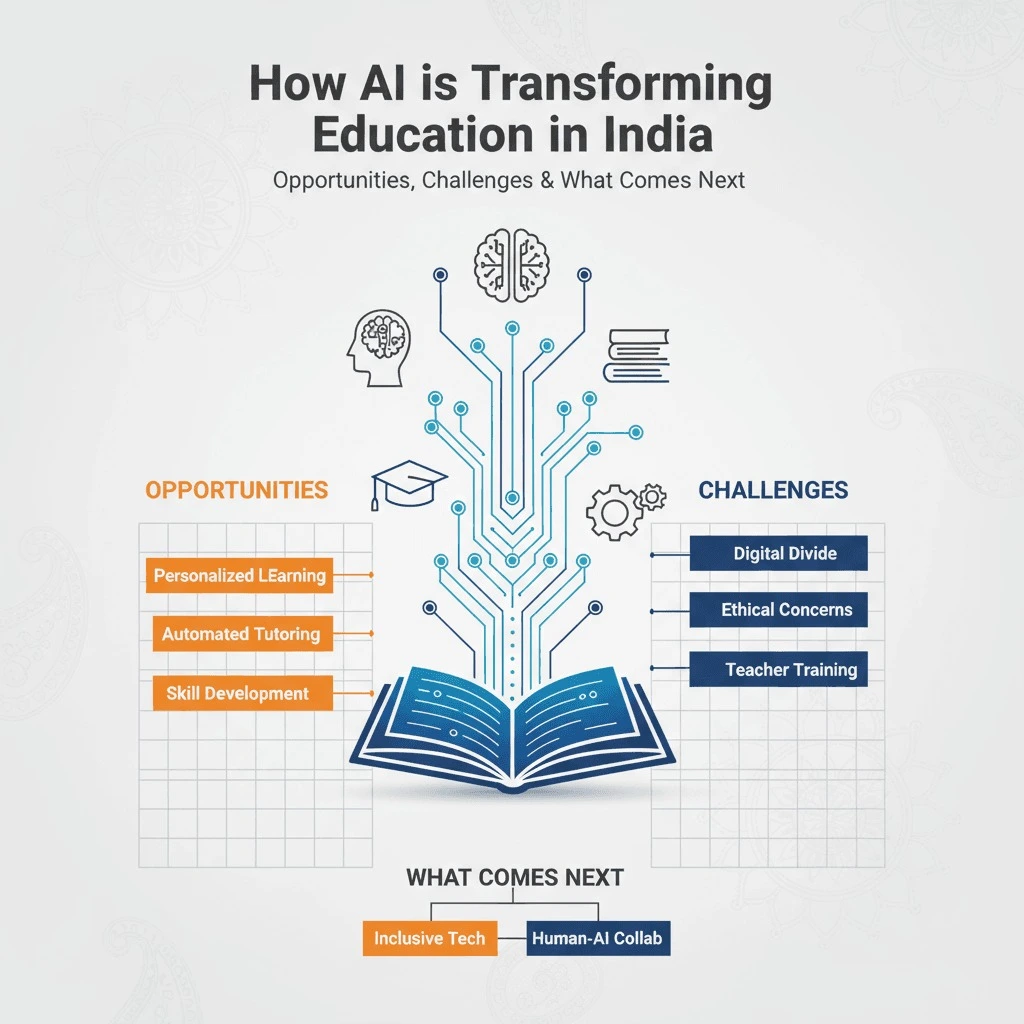
AI-powered personalized education refers to the use of artificial intelligence — including machine learning models, natural language processing, predictive analytics, and data-driven algorithms — to deliver learning experiences that adapt uniquely to each student. Instead of giving every learner the same book, the same lesson, and the same pace, AI creates a continuously optimized learning journey based on real-time understanding of the student.
At its core, AI collects and analyzes thousands of micro-data points while a student studies. These include:
✔ Student Ability
AI evaluates how quickly a student grasps new concepts, how they perform across subjects, and which topics require more foundational explanation.
✔ Strengths & Weaknesses
It identifies the student’s strong areas (e.g., conceptual clarity, calculation speed) and weak areas (e.g., application-based questions, reading comprehension), then adjusts the lesson difficulty accordingly.
✔ Pace of Learning
Some students learn concepts rapidly but struggle with practice questions; others need repetition or slower progression. AI automatically adapts the speed.
✔ Preferred Learning Formats
AI recognizes whether the student learns best through:
- Visual videos
- Audio explanations
- Interactive quizzes
- Gamified lessons
- Case studies
- Step-by-step text guides
It then prioritizes the formats that work best for them.
✔ Past Performance
AI systems track how a student performed in earlier modules, assignments, mock tests, or exams — using this history to predict future performance and customize revision plans.
✔ Behavioral Patterns
AI observes behaviors such as:
- Time spent on each question
- When the student hesitates
- When attention drops
- Which mistakes repeat
- What types of questions cause stress
This helps the system intervene at the right moments.
✔ Engagement Levels
If a student loses interest or shows fatigue, AI adjusts the format, adds gamification, offers hints, or simplifies content to restore focus.
How AI Changes the Traditional Education Model
In traditional classrooms, one teacher explains the same topic to 40–80 students — all with different abilities, backgrounds, and learning needs. The model assumes everyone learns the same way.
AI completely disrupts this by offering:
- Adaptive learning paths: dynamically evolving based on performance
- Customized difficulty: easy → medium → tough progression personalized
- Predictive recommendations: “Revise algebra today,” “Practice reading comprehension,” etc.
- Personalized assessments: tests that adjust in real time
- Individualized progress tracking: dashboards for students, parents, and teachers
This transforms learning from a generalized, uniform approach to a personalized, flexible, and intelligent system, where every student learns at the right pace, with the right kind of content, at the right time.
Simply put:
👉 AI ensures students don’t just learn — they learn the way that works best for them.
Global & India EdTech Market Trends (2025)
🌍 Global Trends
The global EdTech landscape is undergoing a massive shift as AI becomes central to how students learn, teachers teach, and institutions operate. According to McKinsey and HolonIQ, the AI in education market is projected to reach $6.2 billion in 2025, with a steep growth curve pushing it towards $25–30 billion by 2030. This surge is driven by increased investment in adaptive learning systems, AI tutors, and automated assessment tools.
Surveys show that 64% of students worldwide use at least one AI-powered learning tool every week (Statista 2024). Tools span from automated revision apps and plagiarism checkers to full-fledged AI tutors that deliver personalized explanations and study plans.
Major global platforms are integrating AI deeply into their ecosystems:
- Khan Academy’s “Khanmigo” acts as an AI teaching assistant and tutor.
- Coursera and edX now offer AI-curated course pathways and skill assessments.
- Duolingo’s AI-driven “Birdbrain” personalizes difficulty levels for every learner.
This global adoption signals a shift toward hyper-personalized, self-paced learning ecosystems that cater to individual student needs at scale.
🇮🇳 India-Specific Trends
India is one of the world’s fastest-growing EdTech markets, fueled by affordability, smartphone penetration, and government-backed digital learning initiatives. Reports from RedSeer estimate that the Indian EdTech sector, valued at $4.5 billion in 2024, will touch $10 billion by 2030, with AI playing a crucial role in this growth.
Over 300 million students are already using AI-based learning platforms across India — including DIKSHA for public school learners, BYJU’S for K–12 and test prep, and Physics Wallah for competitive exams. These platforms use AI to deliver adaptive quizzes, personalized revision, student progress analytics, and real-time feedback.
Government initiatives are accelerating this transformation. The National Education Policy (NEP) 2020 explicitly promotes:
- Personalized and competency-based learning
- AI literacy for all students
- Integration of emerging technologies in classrooms
In addition, the government’s AI-for-All initiative, NDEAR framework, and digital public infrastructure (DPI) are helping schools—especially in Tier 2/3 cities—adopt AI-powered learning tools at scale.India’s trajectory shows that AI-powered education is not just a trend; it’s becoming a national strategy for future-ready learning.
How AI Personalizes Education: 10 Game-Changing Methods
1. Adaptive Learning Paths
AI-powered systems continuously analyze a student’s responses, speed, accuracy, and engagement to adjust the difficulty level of lessons.
Instead of following a fixed curriculum, the platform adapts in real time — giving easier questions when a student struggles and gradually increasing complexity when they show mastery. This ensures that every learner moves at their optimal pace, neither bored nor overwhelmed.
2. AI Tutors (24/7 Learning Support)
Generative AI tutors act like on-demand personal teachers. They can:
- Break down complex concepts in simple language
- Provide step-by-step solutions
- Generate summaries, quizzes, and personalized notes
- Explain the same topic in multiple ways (visual, textual, conversational)
- Offer unlimited doubt-solving, anytime
This eliminates the dependency on fixed classroom timings and gives every student an accessible, cost-effective learning assistant.
3. Smart Assessments (Beyond Right or Wrong)
AI doesn’t just grade answers — it studies the patterns in mistakes.
If a student repeatedly gets algebraic signs wrong, or struggles with comprehension questions, the system identifies these micro-gaps and recommends:
- Targeted revision modules
- Additional practice questions
- Alternative explanations
- Difficulty adjustments
This transforms assessments into diagnostic tools, not just score sheets.
4. Real-Time Feedback
Traditionally, students wait hours or days to know whether they understood a concept.
AI provides immediate, context-aware feedback — pointing out why an answer is wrong and how to correct it.
Studies from MIT show that real-time feedback can improve learning efficiency by up to 4×, because students fix mistakes instantly instead of repeating them.
5. Personalized Content Formats
AI tailors the format of study material to each student’s preferred learning style.
The same lesson can be delivered as:
- Videos (visual learners)
- Audio explanations (auditory learners)
- Short stories/narratives (contextual learners)
- Interactive quizzes (active learners)
- Case studies (applied learners)
This eliminates the “one-size-fits-all” model and helps every student learn in the way they understand best.
6. Predictive Analytics (Dropout & Struggle Detection)
AI continuously monitors engagement levels, attendance, assignment submissions, and test scores to predict when a student is:
- Losing interest
- Falling behind
- At risk of failing or dropping out
The system sends alerts to teachers and parents, enabling early intervention.
Schools using predictive analytics have reported significant improvements in student retention and performance.
7. Personalized Career Guidance
By analyzing academic strengths, weaknesses, behavioral traits, and interest patterns, AI recommends:
- Suitable career paths
- Skill gaps to fill
- Relevant courses
- Competitive exams
- Future job market predictions
This transforms career counselling from generic advice into data-driven guidance, giving students clarity much earlier in their academic journey.
8. AI for Special Education Needs (SEN)
AI makes learning more accessible for students with disabilities through:
- Speech-to-text tools for students with writing or motor challenges
- Text-to-speech for dyslexia or visual impairments
- Personalized reading assistance with adjustable fonts, pacing, and comprehension tools
- Behavioral analysis for ADHD or autism support
- Adaptive practice exercises based on cognitive abilities
This helps bridge learning gaps and makes education more inclusive.
9. Gamified Personalized Learning
Gamification increases motivation by turning learning into a game. AI personalizes:
- Difficulty of challenges
- Type of rewards
- Badges and point systems
- Skill levels and progression
- Learning streaks and milestones
By customizing these elements to each student’s profile, AI keeps learners engaged for longer and boosts retention rates.
10. AI-Generated Study Plans
AI creates dynamic, personalized study schedules based on:
- Student goals (exams, grades, projects)
- Available time per day
- Learning speed
- Past performance
- Upcoming deadlines
The plan updates automatically depending on progress, ensuring that students stay on track without feeling overwhelmed. This is especially useful for exam prep (NEET, JEE, UPSC, SAT, IELTS).
Benefits for Students (Backed by Research)
📌 1. Faster Learning
AI-powered adaptive systems help students learn significantly faster by customizing the pace and difficulty of lessons.
According to the Knewton Adaptive Learning Report, personalized learning paths can improve learning speed by 35–45%, because students skip concepts they already understand and spend extra time on weak areas. This prevents cognitive overload and reduces wasted time, allowing learners to progress far more efficiently than in traditional classrooms.
📌 2. Higher Retention Rates
Personalized learning doesn’t just make students faster — it helps them remember more.
IBM’s eLearning effectiveness study found that adaptive and personalized content boosts retention rates by 25–60%. When students learn through preferred formats (video, audio, stories, quizzes), their brain absorbs and recalls information more effectively.
AI further reinforces retention through:
- spaced repetition
- micro-learning
- personalized revision schedules
- continuous progress tracking
This ensures long-term mastery instead of short-term memorization.
📌 3. More Confidence & Less Stress
AI-based learning removes traditional classroom pressures such as:
- fear of asking doubts
- comparison with peers
- fast-paced teaching that some students can’t keep up with
- judgment over “slow learning”
Students can learn at their own pace, repeat lessons without embarrassment, and receive explanations tailored to their cognitive style. This builds academic confidence, reduces anxiety, and makes learning emotionally safer.
Research shows that personalized feedback significantly improves student comfort and reduces stress-related performance drops.
📌 4. 24/7 Doubt Solving
AI tutors and chatbots can solve up to 80% of student queries instantly (EdTech AI Automation Benchmark 2024).
This gives learners round-the-clock access to:
- concept explanations
- step-by-step solutions
- alternative methods
- real-life examples
- practice questions
Instead of waiting until the next class or coaching session, students clarify doubts immediately — which plays a huge role in preventing small gaps from becoming large academic weaknesses.
📌 5. Equal Access for Tier-2/3 India
AI is reducing the education gap between metro and non-metro India.
Voice-based, multilingual, and low-data learning tools make high-quality education accessible to:
- non-English medium students
- students from government schools
- learners without formal coaching centers nearby
AI tools can convert English content into native languages, simplify complex text, and provide audio-based learning for students who struggle with reading. This levels the playing field and ensures that education quality isn’t limited by geography or language.
Real-World Examples & Case Studies
📌 Case Study 1: Duolingo Max (Global) — AI-Driven Language Personalization
Duolingo Max, powered by OpenAI’s GPT-4, represents one of the world’s most widely adopted examples of AI-driven personalized learning.
Duolingo uses AI algorithms to analyze learner speed, error patterns, pronunciation accuracy, memory retention, and even emotional engagement signals (based on streak consistency).
How AI Personalizes Learning:
- Adjusts lesson difficulty dynamically after every exercise
- Generates personalized dialogues and role-play conversations
- Explains mistakes in natural language based on learner history
- Recommends revision modules based on forgetting curve predictions
Outcome & Impact:
- Duolingo reported a 30% increase in learner engagement after introducing AI-based feedback and conversational role-play.
- Completion rates for difficult modules improved significantly, especially among beginners who previously dropped out early.
- The app now handles millions of personalized learning paths daily, something impossible with human instruction alone.
Relevance for India:
India is Duolingo’s fastest-growing market, with millions using the app for IELTS/TOEFL prep and English communication — AI-driven personalization makes this possible at scale.
📌 Case Study 2: Khanmigo (USA) — AI Tutor Doubling Concept Mastery
Khan Academy’s AI tutor Khanmigo is a prime example of classroom-integrated personalized learning. Supported by GPT models, Khanmigo acts as a digital tutor that guides students step-by-step rather than simply giving answers.
How AI Helps Students:
- Breaks down problems according to each student’s thinking style
- Tracks cognitive patterns and suggests hints instead of solutions
- Generates quizzes, explanations, and examples in real-time
- Helps teachers identify struggling students before they fall behind
Results Observed in Pilot Schools:
- Schools participating in Khanmigo trials reported ~2× improvement in math concept mastery for middle school students.
- Students showed higher motivation and spent more time practicing difficult topics voluntarily.
- Teachers reported reduced workload due to automated grading, personalized worksheets, and instant analytics.
Why It Matters for India:
Platforms like Teachmint, Cuemath, and LEAD School are beginning to adopt similar AI tutor models for CBSE, ICSE, and state board students.
📌 Case Study 3: Physics Wallah (India) — AI-Driven Exam Personalization
Physics Wallah (PW), one of India’s largest learning platforms, is integrating AI for adaptive test analysis, personalized revision, and content optimization for JEE/NEET aspirants.
How AI Personalizes Preparation:
- Detailed test analysis identifies micro-level weaknesses:
- chapter-level
- sub-topic level
- question type
- time taken
- chapter-level
- Generates personalized revision sheets based on past tests
- AI flags conceptual gaps and recommends specific video lectures
- Predicts potential score improvement per revision cycle
Measured Impact:
- Students using AI-powered test analytics showed higher accuracy and faster question-solving speeds in mock exams.
- Dropout rates for difficult topics decreased due to targeted revision.
- Personalized plans improved consistency among aspirants preparing without coaching.
Importance for India:
With India’s 3.5 crore competitive exam learners, such AI tools democratize access to high-quality preparation previously available only via premium coaching centers.
Popular AI Tools Personalizing Learning (2025)
AI-powered tools in 2025 are transforming how students worldwide — including millions in India — learn, revise, practice, and understand concepts. These platforms combine generative AI, adaptive algorithms, and real-time analytics to offer highly personalized learning experiences.
🌍 Global AI Tools (2025)
1. Khan Academy — Khanmigo (USA)
What it does:
Khanmigo acts as an AI-powered tutor that converses with students, guides them through problem-solving, and gives hints without revealing answers.
Key Features:
- Step-by-step guidance
- AI-generated practice problems
- In-depth concept explanations
- Teacher dashboards with individualized progress
- Socratic-style questioning
Best For:
Math, science, reading comprehension, coding learners.
Why It Matters:
Khanmigo is being piloted in U.S. schools and sets the global benchmark for AI-integrated classrooms.
2. Duolingo Max
What it does:
An AI-powered language tutor built on GPT-4, helping learners master pronunciation, grammar, vocabulary, and conversational skills.
Key Features:
- AI role-play conversations
- Real-time mistake explanations
- Personalized lesson difficulty
- Adaptive vocabulary training
Best For:
Language learners (English, French, Spanish, Hindi, etc.)
Why It Matters:
Duolingo handles millions of personalized learning experiences daily, showing how scalable AI learning can be.
3. Coursera Coach
What it does:
A personal AI assistant built into Coursera courses to help learners understand complex lessons.
Key Features:
- Video and article summaries
- Quiz and assignment assistance
- Doubt clarification
- AI-generated study notes
- Personalized course progression suggestions
Best For:
College students, working professionals, upskilling learners.
Why It Matters:
Supports 100M+ global learners and makes high-level university content more digestible.
4. Quizlet AI
What it does:
Transforms study materials into personalized flashcards, tests, and quick quizzes.
Key Features:
- AI-generated flashcards
- Memory-based spaced repetition system
- Smart practice powered by student performance
- Gaps analysis for targeted revision
Best For:
Board exams, language learning, competitive exams, factual subjects.
Why It Matters:
Helps students accelerate memorization and concept retention.
5. Notion AI
What it does:
Helps students create personalized notes, summaries, schedules, and study plans.
Key Features:
- Automated note-taking
- AI summaries
- Task planning + reminders
- Brainstorming + idea generation
- Knowledge organization across subjects
Best For:
College students, project-based learners, research-driven students.
Why It Matters:
Makes self-learning, content management, and planning far more efficient.
🇮🇳 India-Focused AI Tools (2025)
1. BYJU’S AI Mentor
What it does:
Personalized AI tutor that adjusts difficulty, provides conceptual explanations, and tailors revision for each student.
Key Features:
- Adaptive learning path
- AI-driven test analysis
- Personalized revision modules
- Concept strengthening videos
- Parent progress dashboard
Best For:
K–12 students, NEET/JEE aspirants.
Why It Matters:
Supports one of the world’s largest student bases and brings high-quality learning to every district.
2. Unacademy Genie
What it does:
AI assistant that helps competitive exam aspirants with personalized question banks and instant doubt-solving.
Key Features:
- Doubt-solving using generative AI
- Personalized test recommendations
- Dynamic practice sets
- Real-time performance feedback
Best For:
UPSC, SSC, CAT, Banking, and state-level exam aspirants.
Why It Matters:
Makes top-tier competitive exam prep more accessible across Tier-2 and Tier-3 cities.
3. Doubtnut
What it does:
AI-based doubt-solving platform where students upload photos of questions and receive instant video + stepwise solutions.
Key Features:
- Picture-based problem detection
- Instant concept videos
- Multilingual support
- Adaptive difficulty suggestions
Best For:
Math and science learners in K–12.
Why It Matters:
Famous for supporting students from government schools and regional boards.
4. PW Satya AI (Physics Wallah)
What it does:
A personalized learning system that evaluates student performance and creates custom revision plans.
Key Features:
- Deep test analytics
- Personalized score improvement plans
- AI-generated revision sheets
- Learning path prediction
- Weak-area-specific video suggestions
Best For:
JEE, NEET, CUET aspirants.
Why It Matters:
Provides high-quality personalization at extremely affordable pricing for Indian students.
5. Google’s Bolo (Read Along)
What it does:
An AI reading tutor for early learners, especially in rural India.
Key Features:
- Real-time reading feedback
- Speech recognition
- Regional language support (Hindi, Marathi, Bengali, Tamil, etc.)
- Engaging story-based lessons
Best For:
Kids aged 5–12, early literacy development.
Why It Matters:
Bridges the learning gap for millions of first-generation learners.
AI in Indian Classrooms: NEP 2020 + DIKSHA
India’s education ecosystem is undergoing a major digital transformation, driven by National Education Policy (NEP 2020) and large-scale government-powered EdTech platforms like DIKSHA, PM eVidya, NDEAR, and SWAYAM. Together, these initiatives aim to create the world’s largest personalized learning ecosystem powered by AI, multilingual content, and accessible digital infrastructure.
📌 Major Government Drives Supporting AI-Based Personalized Learning
1. AI Literacy in K–12 (NEP 2020 Mandate)
NEP 2020 positions AI as a foundational 21st-century skill.
It mandates that students from Classes 6–12 should learn:
- basics of artificial intelligence
- data science and coding
- real-life applications of AI
- ethical use of AI tools
- problem-solving using AI-driven platforms
Schools across CBSE, Kendriya Vidyalayas, and private boards have introduced AI-focused modules in partnership with:
- Intel
- CBSE AI Curriculum
- Microsoft Education
- IBM SkillsBuild
Impact:
- Over 25 lakh+ students have already completed introductory AI modules (CBSE data).
- Students in Tier-2 & Tier-3 cities are getting AI exposure previously limited to metro schools.
2. Personalized Digital Learning Framework (NDEAR Initiative)
Under the National Digital Education Architecture (NDEAR), the government is building an interoperable digital ecosystem where every student can have a unique learner profile.
This allows AI systems to track:
- learning progress
- strengths and weaknesses
- preferred learning format
- exam readiness
- language proficiency
This data powers personalized recommendations, exactly like global EdTech platforms.
Vision:
By 2030, every Indian student could have a digital AI-assisted learning passport.
3. DIKSHA 2.0 – Personalized Recommendations at Scale
DIKSHA (Digital Infrastructure for Knowledge Sharing) is India’s largest school education platform with 300 million+ learners.
DIKSHA 2.0 Enhancements Include:
- AI-based adaptive content suggestion
- personalized learning paths for K–12
- multilingual content auto-translation
- intelligent textbook-linked QR codes
- learning gap identification for teachers
- cognitive difficulty-level mapping for each child
Every student who scans a QR code in their NCERT/State Board book gets personalized lessons, quizzes, and videos, making learning more contextual and accessible.
Why It Matters:
It is the first government platform in the world to offer personalized learning at a national scale.
4. PM eVidya – A Multimodal AI-Powered Ecosystem
Launched during the pandemic and integrated into NEP 2020, PM eVidya ensures no child is left behind.
It includes:
- 200+ DTH TV Channels (One Class, One Channel)
- Radio + community learning programs
- e-Content on DIKSHA
- AI-driven sign language videos
- SWAYAM Prabha live classes
- Virtual labs (ATL, PM eVidya Labs)
AI helps personalize content delivery for learners with limited internet access by:
- recommending the best medium (TV vs mobile vs radio)
- auto-adjusting content difficulty
- providing language translations
Inclusivity Impact:
Supports millions of students in villages with low connectivity or no smartphones.
📌 India’s AI-in-Education Future: A High-Growth 2025–2035 Opportunity
India is aggressively adopting AI in classrooms because:
- It has the world’s largest student population (over 260 million school students).
- There’s a strong push for digital public infrastructure similar to UPI & Aadhaar.
- AI helps bridge gaps between top-tier private schools and government schools.
Expected Growth by 2035:
- AI-supported content in all NCERT and most state board textbooks
- Personalized learning dashboards for every child
- AI-driven teacher assistants for workload reduction
- Adaptive assessments for all competitive exams
- Multilingual AI tutors accessible even offline
- India emerging as a global hub for affordable AI EdTech exports
Result:
A truly personalized learning system for every student in every state, regardless of socio-economic background.
Challenges & Ethical Concerns
While AI is revolutionizing education, it also comes with serious challenges and moral considerations. These concerns must be addressed to ensure AI benefits students safely, fairly, and responsibly — especially in India, where millions of minors rely on digital learning platforms.
📌 1. Data Privacy & Safety of Minors
AI-powered education platforms collect large volumes of student data, including:
- learning behavior
- performance history
- voice recordings
- handwriting or image uploads
- biometric patterns (from proctoring tools)
- personal profile information
The risk:
If this data is mismanaged, leaked, or misused, it can endanger children’s privacy and future opportunities.
Key Concerns:
- Inadequate encryption on low-cost platforms
- Third-party data sharing without parental consent
- Big data profiling of minors
- Lack of clear government regulations on AI data use in schools
- Over-collection of sensitive data through proctoring apps
India Context:
India’s new Digital Personal Data Protection Act (DPDPA 2023) mandates stricter safeguards for minors’ data, but compliance is still evolving across EdTech providers.
📌 2. Bias in AI Algorithms
AI systems learn from historical datasets — and these datasets often contain hidden biases.
Examples of educational bias include:
- AI recommending easier content to students from specific regions or languages
- Speech recognition systems working better for American or British accents than Indian accents
- Image-based doubt-solving struggling with regional handwriting styles
- Career recommendation algorithms reinforcing stereotypes
(e.g., recommending humanities more often to girls or rural students)
Why it matters:
Biased AI can reinforce inequalities rather than reduce them.
For India, with 1,600+ mother tongues and diverse socio-economic groups, biased AI can unintentionally disadvantage entire communities.
📌 3. Unequal Access to AI Tools (Digital Divide)
AI-enabled learning often requires:
- smartphones
- stable internet
- updated apps
- digital literacy
Millions of students in India — especially in Tier-3 cities, villages, and tribal regions — may not have these.
Barriers include:
- Shared device usage (one smartphone for a whole family)
- Low-speed 4G/3G networks
- Poor Wi-Fi availability in government schools
- High data consumption by AI content
- Language barriers despite personalization
Impact:
The gap between well-connected and low-resource learners may widen if AI adoption is uneven.
Government initiatives like PM eVidya, BharatNet, and DIKSHA QR textbooks are helping, but challenges remain.
📌 4. Over-Dependency on AI
While AI provides quick answers and explanations, excessive dependence can reduce:
- critical thinking
- problem-solving abilities
- deep work habits
- conceptual understanding
- creativity
Students may begin relying on AI to:
- generate homework
- solve math problems without understanding steps
- summarize long chapters instead of reading
- write essays and assignments
This can create a generation of passive learners if not balanced with teacher supervision and self-effort.
Teacher insight:
Educators worry that students “follow the AI tutor blindly” without questioning the logic or verifying accuracy.
📌 5. Teacher Training Gaps
AI can only be successful in classrooms if teachers understand how to use it effectively.
Current challenges:
- Many teachers are unfamiliar with AI tools
- Lack of structured AI-training programs in teacher education
- Fear of being replaced by AI reduces adoption
- Limited time to learn new technologies
- Resistance due to workload pressure
India’s NEP 2020 encourages digital pedagogy, but large-scale teacher training is still a work in progress.
Important reality:
AI should empower teachers — not replace them.
But without training, teachers cannot guide students on safe, effective AI usage.
Future of AI-Powered Personalized Education (2025–2035)
AI in education is moving from being a supportive add-on to becoming a full-fledged learning companion that understands every student’s strengths, struggles, preferences, and aspirations. Over the next decade, classrooms will shift from standardized instruction to deeply individualized learning ecosystems powered by real-time data and intelligent tutoring systems. This evolution will redefine how students study, how teachers teach, and how assessments are designed — making learning more efficient, inclusive, and outcomes-driven.
What to Expect in the Next 10 Years
1. Universal AI Tutors for Every Student
By 2030, every student—urban or rural—is likely to have access to a 24/7 multilingual AI tutor on their phone. These tutors will explain concepts in simple language, generate personalized quizzes, track progress, and even adjust teaching styles (visual, auditory, interactive) based on the learner’s comfort. AI tutors will become as common as calculators once were.
2. Real-Time Adaptive Board Exams
Exams will no longer be “one-paper-for-all.”
Boards like CBSE, ICSE, and state boards are expected to adopt adaptive testing, where question difficulty changes in real time based on the student’s performance.
This ensures:
- Fairer evaluation
- Reduced exam anxiety
- More accurate measurement of skills
3. AI-Generated Personalized Textbooks
Instead of static textbooks, AI will generate dynamic digital textbooks unique for every learner. These will include:
- Explanations based on student’s reading level
- Real-world examples linked to their interests
- Custom practice questions
- Interactive visuals
- Automatic updates aligned with syllabus changes
Each student’s textbook will look different — because each student learns differently.
4. Full Digital Student Twins (Learning Profiles)
Schools will maintain “digital twins” — complete AI-driven learning profiles containing:
- Strengths & weaknesses
- Preferred learning style
- Past performance analytics
- Emotional/behavioral learning insights
- Career inclination predictions
Teachers will use these profiles to adjust instruction and intervention with precision.
5. 100% Personalized Classrooms
Classrooms will stop grouping students by age; instead, they will be grouped by learning progress level.
AI systems will:
- Recommend daily lesson plans to teachers
- Cluster students based on concept mastery
- Flag students who need interventions
- Personalize homework and revision plans
Traditional instruction will shift to hyper-personalized learning paths for every child.
India’s Future: The World’s Largest AI Learning Market
With NEP 2020, DIKSHA 2.0, UDL frameworks, and rapid EdTech adoption, India is on track to become the largest market for AI-driven education globally.
Massive student populations, smartphone penetration, and government-backed digital learning ensure that India will lead the world in personalized AI education by 2035.
FAQs Section
1. What is personalized learning with AI?
AI-powered personalized learning is an advanced educational method where software uses machine learning, predictive analytics, natural language processing (NLP), and behavioral data to customize learning experiences for each student. Instead of giving one common syllabus or pace, AI studies performance trends, quiz accuracy, time spent on tasks, learning behavior, and content preference. It then automatically adjusts difficulty, provides targeted explanations, generates personalized practice sets, and recommends the next steps in the learning journey.
In simple terms: AI acts like a private tutor who understands how you learn, what you struggle with, and what motivates you — and adapts lessons accordingly.
2. How does AI help slow or struggling students?
AI offers powerful support for students who find certain topics difficult. It identifies exactly where the student is struggling — whether it’s conceptual gaps, slow speed, low confidence, or poor practice patterns. Then it provides:
- Simplified explanations written at their level
- Micro-lessons that break hard topics into bite-sized concepts
- Step-by-step solved examples
- Adaptive difficulty that increases only when the student is ready
- Instant feedback after every question
- Visual or interactive explanations for complex ideas These tools remove fear and pressure, allowing slow learners to improve naturally. AI essentially ensures no child is left behind, even without expensive coaching.
3. Does AI replace teachers?
No — and it never will. AI cannot replace human qualities such as empathy, emotional understanding, motivation, and creative teaching strategies. Instead, AI acts as a super assistant that automates repetitive tasks like:
- Grading objective tests
- Generating question banks
- Tracking student progress
- Identifying learning gaps
Creating personalized study plans
This frees up teachers to focus on what truly matters: mentoring, creative teaching, emotional support, one-on-one guidance, and bringing real-world context into lessons.
The future of education is “AI + Teachers = Personalized, scalable learning for everyone.”
4. What are the best AI tools for students in India?
India has rapidly become a global hub for AI-driven education. Some of the most effective tools that offer adaptive learning, doubt solving, and personalized analytics are:
- PW Satya AI – AI test analysis + personalized revision
- BYJU’S AI Mentor – adaptive learning paths + concept videos
- Doubtnut AI – instant doubt solving using OCR and NLP
- Unacademy Genie – AI-based learning assistant for exam prep
- Google Read Along (Bolo) – voice-based learning for young readers These tools improve retention, exam readiness, and conceptual clarity, especially for CBSE, NEET, JEE, UPSC, and SSC aspirants.
5. Is personalized AI learning expensive?
Not necessarily. In fact, AI learning is becoming cheaper than traditional coaching, thanks to freemium pricing. Most platforms offer:
- Free doubt-solving
- Free quizzes and tests
- Free personalized recommendations
- Free access to basic AI tutors Paid subscriptions typically unlock deeper analytics, advanced practice sets, and 1-on-1 support — often at a fraction of offline tuition fees. Government platforms like DIKSHA 2.0, NROER, PM eVidya make AI-powered personalized learning almost zero-cost for millions of students.
6. Is AI safe for school children?
AI can be safe if platforms follow proper data protection standards. To ensure safety, parents and schools should look for:
- Tools that comply with India’s DPDP Act
- Clear privacy policies stating how student data is used
- No collection of unnecessary personal information
- No targeted ads or intrusive tracking
- Parental dashboards and controls When used responsibly, AI offers a safe way for children to learn through interactive explanations, voice support, and adaptive guidance.
7. Can AI help with board exam preparation?
Yes — AI is extremely effective for CBSE, ICSE, and state board exam preparation. AI systems generate:
- Personalized study plans based on exam dates
- Daily revision schedules
- Topic-wise weightage indicators
- Adaptive mock tests with difficulty scaling
- Error analysis that shows the exact reason behind wrong answers
- NCERT-aligned concept explanations AI also tracks syllabus completion and revision frequency, ensuring students stay on track for high-scoring performance. For board exam students, AI becomes a 24/7 study partner that removes guesswork from preparation.
8. Does AI improve learning outcomes?
Yes. Multiple studies from MIT, Stanford, Knewton, IBM, and HolonIQ show that AI-driven learning leads to:
- 35–45% faster comprehension
- 25–60% higher retention
- 2× improvement in concept mastery through adaptive feedback
Reduced stress and improved confidence
AI ensures students get the right content at the right time — no more confusion, random guessing, or overload. This precision makes learning efficient and measurable.
9. How does AI personalize learning for different skill levels?
AI categorizes learners into profiles such as beginner, intermediate, advanced, visual learner, slow learner, fast learner, etc., by analyzing:
- Time spent per question
- Accuracy rate
- Behavior patterns
- Repeated mistakes
- Attention span
- Past performance
It then tailors learning paths accordingly: - Fast learners get advanced problems and competitive-level challenges.
- Struggling learners get simpler explanations, lower difficulty, and more practice.
- Visual learners get videos and diagrams.
- Auditory learners get audio-based lessons. Each learner gets a custom journey, just like having a personal home tutor.
10. Can AI help non-English medium or rural students?
Yes — AI is one of the biggest breakthroughs for rural and regional-language education. AI tools now offer:
- Multilingual content (Hindi, Tamil, Telugu, Bengali, Marathi, etc.)
- Voice-based interaction for students with weak reading skills
- Regional accent recognition
Simple language explanations for complex topics
This levels the playing field for Tier-2/3 students, ensuring equal access to high-quality personalized learning, even without English fluency or expensive coaching.
11. What are the limitations or risks of AI in education?
Despite its benefits, AI comes with challenges:
- Data privacy risks – Sensitive student data must be protected
- Algorithmic bias – AI predictions can be skewed due to biased datasets
- Unequal access – Students without devices or internet may be left behind
- Over-dependence – Excessive reliance may reduce critical thinking
- Teacher readiness – Schools need training to use AI effectively Addressing these concerns requires strong regulation, responsible technology usage, and digital infrastructure expansion.
12. What is the future of AI-powered education in India?
Between 2025 and 2035, India is expected to lead the world in AI-based learning due to its scale, government initiatives, and large student population. The future will include:
- Universal AI tutors available in every classroom
- AI-powered board exams with adaptive difficulty
- Personalized digital textbooks for every student
- Digital learning twins — AI clones that track strengths, weaknesses, and learning pace
- Fully adaptive classrooms where each student learns at their own speed
- AI integration in every school under NEP 2020 India is on track to become the largest market for AI education, reshaping how the next generation learns.
Summary
1. AI is reshaping education by delivering hyper-personalized learning paths.
Artificial intelligence now analyzes student behavior, pace, strengths, and weaknesses to create customized learning journeys that adapt in real time. This means each student receives the right difficulty level, the right explanations, and the right practice material at exactly the right time — something traditional classrooms could never scale.
2. Students learn faster, retain more information, and experience significantly less stress.
Research-backed adaptive systems help students learn 35–45% faster, while personalized revision models improve retention anywhere from 25–60%. Because AI eliminates peer pressure and learning anxiety, students feel more confident, more in control, and far better supported throughout their academic journey.
3. India is quickly emerging as the world’s biggest hub for AI-integrated education.
With NEP 2020, DIKSHA 2.0, PM eVidya, and massive adoption from EdTech giants like Physics Wallah, BYJU’S, Unacademy, and Vedantu, India is leading globally in affordable, scalable AI-powered classroom experiences. Over 300 million learners are already benefiting from AI-driven personalization.
4. AI tutors, adaptive testing engines, and predictive analytics are redefining how students prepare and perform.
From 24/7 AI tutors that solve doubts instantly to adaptive mock tests that adjust difficulty based on performance, AI is enabling precision learning. Predictive analytics now identify struggling students early, recommend targeted practice, and help teachers personalize interventions without extra effort.
5. Personalized content formats are unlocking new ways to learn for diverse students.
AI transforms a single chapter into video explanations, audio summaries, quizzes, flashcards, stories, case studies, and gamified tasks, making learning accessible for visual, auditory, slow, fast, and multilingual learners. This flexibility is especially beneficial for Tier-2/3 India and non-English-medium students.
6. Over the next decade, AI will push education toward fully personalized, student-centric ecosystems.
Between 2025 and 2035, AI will evolve into a universal learning companion with features like digital learning twins, real-time adaptive board exams, AI-created textbooks, and 100% customized classrooms. The future of education will be personalized, data-driven, multilingual, and accessible to every learner — regardless of background or location.
Conclusion
AI is no longer just an add-on in education — it has become the core engine powering how students learn, practice, and progress. From adaptive learning paths that adjust difficulty in real time to AI tutors that offer instant explanations, examples, and doubt-solving, today’s learning experience is more personalized, responsive, and student-centric than ever before. The shift from a “one-size-fits-all” model to individualized learning means every student — whether fast, slow, visual, or auditory — receives support tailored to their pace, style, and goals. This transformation is not just improving efficiency; it’s fundamentally enhancing how students build understanding, confidence, and long-term mastery.
In practical terms, AI eliminates barriers that once held students back. Predictive analytics identify learning gaps before they become serious problems. Smart assessments show why mistakes happen and how to fix them. Personalized study schedules, multimodal content formats, and gamified learning keep students motivated while reducing stress and cognitive overload. For parents and teachers, AI provides clarity through actionable insights, performance tracking, and early intervention cues — something impossible to achieve manually at scale.
For India — a country with 260M+ school students and millions more preparing for competitive exams — AI in education is more than an innovation; it is a transformative equalizer. It bridges gaps faced by first-generation learners, rural students, and non-English speakers through voice learning, multilingual AI explanations, and low-cost adaptive tools. Over the next decade, AI-powered personalized education will not only accelerate academic outcomes but also democratize high-quality learning for all socioeconomic backgrounds. This shift will shape a more skilled, confident, and future-ready generation capable of thriving in a global digital economy.
References & Sources
Below are the key authoritative sources used for data, statistics, and insights related to AI in education:
- McKinsey – AI in Education Analysis
🔗 https://www.mckinsey.com/industries/education/our-insights/how-artificial-intelligence-is-transforming-the-world-of-education - HolonIQ – Global EdTech & AI Market Outlook
🔗 https://www.holoniq.com/edtech - Statista – AI Adoption in Education Stats
🔗 https://www.statista.com/topics/9621/artificial-intelligence-in-education/ - RedSeer – India EdTech Industry Reports
🔗 https://redseer.com/reports/ - Government of India – NEP 2020 Policy Document
🔗 https://www.education.gov.in/nep/ - DIKSHA – Digital Learning Platform (Govt. of India)
🔗 https://diksha.gov.in/ - IBM – eLearning Effectiveness Research
🔗 https://www.ibm.com/downloads/cas/GB8ZMQZV - MIT – Adaptive Learning & Real-Time Feedback Research
🔗 https://news.mit.edu/topic/artificial-intelligence - UNESCO – AI in Education Reports & Ethics Framework
🔗 https://www.unesco.org/en/artificial-intelligence/education - World Economic Forum – Future of Jobs & AI Skills
🔗 https://www.weforum.org/reports/
